Hannibal Barca lost half his army crossing the Alps. Elephants. Horses. Men frozen solid in mountain passes or tumbled off cliff faces into rivers nobody bothered to name. The survivors stumbled into Italy in 218 BC carrying frostbite, dysentery, and the kind of thousand-yard stare that would not get a clinical name for another two thousand years.
Roman charity did not keep that broken army fighting. Carthaginian medics did. They understood something most commanders still fail to grasp: an army’s capacity to absorb punishment determines how long it stays in the fight. Hannibal’s attention to medical care let him terrorize Rome for sixteen years with minimal reinforcement from home.
The guerrilla medic is not a new idea. The technology just keeps evolving around it.
In Light Fighter Manifesto Volume III, disruptor_26 (@Sentinel_Society / @Disruptor26) introduced the term “Guerrilla Assault Medicine.” The concept merges tactical medicine, wilderness medicine, disaster response, and improvisation into one discipline. He called the medic “the witch doctor, the zulu, the medicine man. The one who can create pure fuckin’ magic by hunting, harming, and healing.”
The Golden Hour Died Outside Bakhmut
In 2009, Defense Secretary Robert Gates mandated that critically wounded casualties reach surgical care within sixty minutes. The “golden hour” policy cut case fatality rates from 13.7% to 7.6% in Afghanistan. Helicopters flew wherever they wanted. Surgeons waited at forward bases with blood products warming.
Ukraine does not have that luxury. Russia contests every altitude with drones, missiles, and man-portable air defense systems. The wounded move by pickup truck, armored vehicle, or whatever still has fuel. Point of injury to surgeon now averages six to eight hours. Sometimes twenty-four.
The medic who builds his entire practice around a sixty-minute evacuation window will spend a lot of time wondering why the helicopter never showed.
Prolonged Field Care
The Committee on Tactical Combat Casualty Care released a position statement in May 2024. The message was simple: when evacuation gets delayed, somebody has to keep the casualty breathing. Ukrainian medics had been living that reality for two years.
Prolonged field care stretches TCCC from minutes into hours or days. Damage control resuscitation. Tourniquet conversion and reassessment. Pain management beyond a single ketamine push. Monitoring for shock in patients whose bodies are working overtime to hide it.
The College of Remote and Offshore Medicine partnered with TacMed North in summer 2024 to run damage control resuscitation courses in Ukraine. Instructors watched participants struggle. The concepts contradicted civilian medical training. Allow lower blood pressure than normal. Tolerate lower oxygen levels. Resist the instinct to push IV fluids.
Old habits get people killed when the doctrine shifts underneath them.
Blood Forward
Low-titer group O whole blood eliminates the logistical nightmare of matching plasma-to-red-cell-to-platelet ratios while someone bleeds out in a foxhole. No calculations. No ratios. You replace what they lost with the closest thing available.
The Ranger Regiment runs the ROLO program. The Marines have Valkyrie. Both train personnel to collect and transfuse fresh whole blood under field conditions.
Ukraine adopted these protocols because they had no choice. When evacuation takes half a day, fluid resuscitation alone cannot bridge the gap. The casualty needs blood. Someone on your team needs to be that blood, or know how to tap the walking blood bank you should have identified before stepping off.
This is not hospital medicine. This is Gladiator medicine. Juba packing Maximus’s wounds with whatever keeps the rot out and the blood in. The tools are more sophisticated now, but the math has not changed: work with what you have, where you are, or watch them die.
The Red Cross as Aiming Point
Russian doctrine treats medical infrastructure as a legitimate target.
September 2024, Donetsk region. Russian forces hit an International Committee of the Red Cross vehicle. Three aid workers dead. The vehicle sat at a planned distribution site, clearly marked, exactly where it was supposed to be. The marking did not protect them. The marking may have been why they got hit.
As of April 2024, the World Health Organization had verified 1,682 attacks on healthcare in Ukraine—128 dead, 288 injured. By August 2024, that number exceeded 1,940, making it “the highest number WHO has ever recorded in any humanitarian emergency globally.” Physicians for Human Rights documented over 1,400 attacks on healthcare facilities, with more than 700 hospitals and clinics destroyed.
Roughly 200 ambulances get damaged or destroyed by Russian shelling every year. Ambulance workers face triple the casualty risk of other healthcare personnel.
The tactical lesson is ugly but impossible to ignore: the red cross is not a shield. In this fight, it is a bullseye.
The Tourniquet Problem
Bleeding from arms and legs remains the leading cause of preventable battlefield death. The tourniquet is the first intervention. It should be the simplest thing a medic does.
Ukraine has documented widespread tourniquet mismanagement. Devices slapped on when direct pressure would have worked. Placement too high on the limb. Tourniquets left cinched for eight hours because nobody knew how to convert them.
Early in the war, cheap Chinese tourniquets flooded Ukrainian supply chains. They snapped under tension. They failed in the cold. Soldiers bled out because someone saved money on a fifteen-dollar piece of kit.
TCCC guidelines call for tourniquet conversion within two hours. After that, tissue starts to die. But the two-hour window assumes evacuation is coming. When evacuation takes twelve hours, the medic faces decisions the guidelines never anticipated.
Robots Do Not Bleed
disruptor_26 wrote about “voice commanding a racing FPV drone to deliver extra drugs at 80mph to your objective” and using ground robots to “extract your patient in a subterranean setting.” In 2023, it read like speculation.
Ukraine made it operational reality.
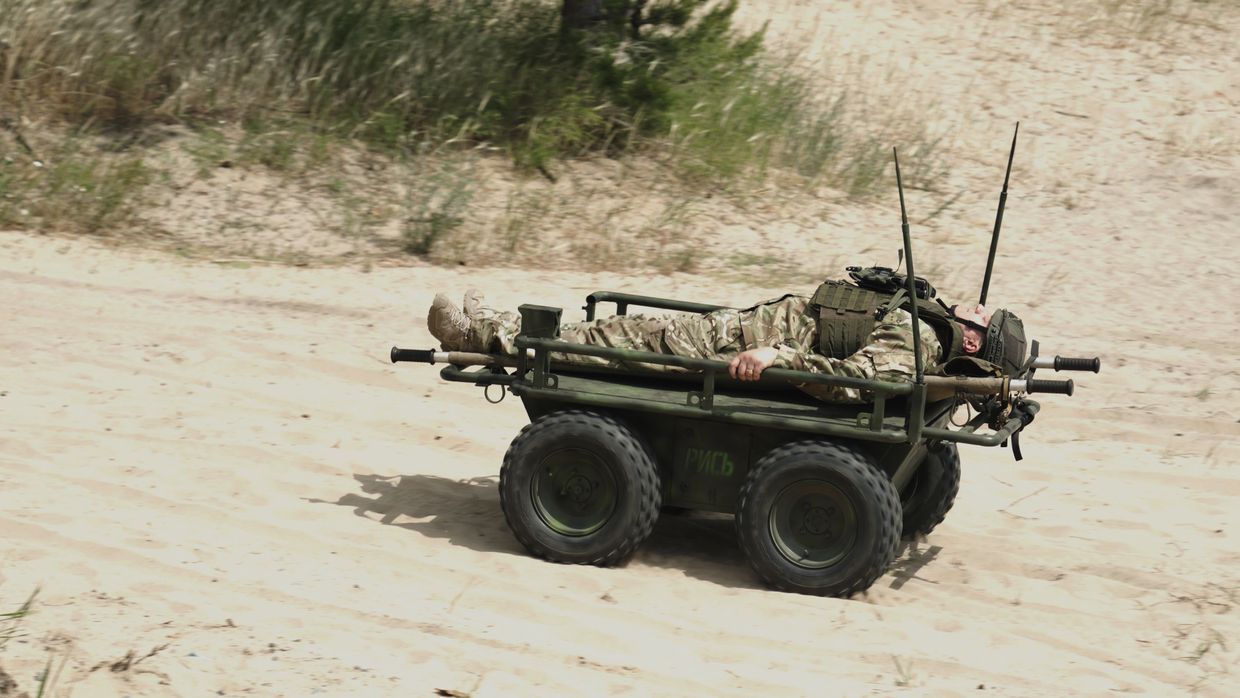
Ground drones for casualty extraction have moved from prototype to mass production. Ukrainian manufacturers built dozens per month in 2024. Now they crank out hundreds. The government plans to field 15,000 ground robotic drones by the end of 2025.
One documented case: a ground robot traveled approximately 40 miles total—23 of them on a damaged wheel after striking a landmine—to rescue a soldier trapped behind enemy lines for thirty-three days. Six manned rescue attempts had failed. The armored capsule protected the soldier even when the robot took a direct strike.
That soldier breathes today because someone took seriously the question: “How creative can you get with manned and unmanned teaming?”
The robot does not bleed. The robot does not leave a family behind. It goes where you cannot.
The AI Medic Teammate
“Be prepared for having another ‘medic teammate’ in the form of a machine.” DARPA took that seriously.
The “In The Moment” program is building an AI-powered triage system for mass casualty events. The U.S. Air Force Research Laboratory dropped $18.5 million in contracts. The goal is offloading cognitive burden when casualties stack up faster than any human can process.
Presage Technologies’ CRM (Compensatory Reserve Measurement) algorithm detects early hemorrhage by analyzing arterial waveforms. The system spots compensated shock before vital signs crash. Triage by machine learning.
The U.S. Army Institute of Surgical Research is partnering with Presage Technologies on bleeding detection algorithms. The problem: the body hides early shock. Defense mechanisms mask the warning signs. A patient can look stable and crash minutes later. The AI watches for patterns the human eye cannot catch.
disruptor_26 called this the medical kill chain. “See. Think. Act.” The machine handles the thinking so the medic can act faster. These systems are now entering operational testing.
Setting Up Shop in the Apocalypse
disruptor_26 asked the critical question: “How well can you hide your medical box and clinic?”
The clinic is a concept, not a location. It exists wherever the medic stops long enough to work and vanishes the moment movement resumes. Bombed-out building, basement, tent that blends with every other tent in the area.
Telemedicine goes in first. PACE-planned comms. Electronic medical devices. Drone integration for resupply and 360-degree awareness.
Biohazard waste and hazmat precautions are the first things forgotten and the first things that compromise your position. Blood on the ground tells a story. Dispose of it or be ready to explain it when the wrong people show up asking questions.
“How soon can I collapse my clinic on exfil and what can I leave behind?”
What Has Not Changed
Hannibal understood medical capability as strategic asset. A force that absorbs casualties and returns fighters to the line outlasts a force that cannot. His medics kept a battered army functional across sixteen years with minimal resupply from Carthage.
The guerrilla medic heading into 2026 faces the same problem with different tools. Drones instead of elephants. AI triage instead of apprenticeship. Whole blood transfusion instead of wound packing with honey and wine.
The job is still what disruptor_26 called it: “Hunt. Harm. Heal.”
The tools change. The mission does not.
Sources
- BMJ Military Health: "‘Golden day’ is a myth: rethinking medical timelines and risk in large scale combat operations" (Dilday et al., November 2024)
- U.S. Army Medical Center of Excellence: Ukraine Medical Lessons Learned Report (June 2025)
- Committee on Tactical Combat Casualty Care: Position Statement on Prolonged Casualty Care (May 2024)
- Military Medicine journal: “Damage Control Resuscitation Ukraine: Small Unit Training in Large Scale Combat Operations” (Oxford Academic)
- World Health Organization: “Triple risk of harm for Ukraine’s health transport workers” (April 4, 2024)
- World Health Organization: “1940 attacks on health care in Ukraine” (August 19, 2024)
- Physicians for Human Rights: “Occupied Hospitals and Surgery in the Dark” (2024)
- ICRC: “Ukraine: 3 ICRC staff killed after shelling hits aid distribution site” (September 2024)
- Kyiv Post: “Ukraine to Deploy 15,000 Robotic Systems to Front Lines in 2025”
- Army Recognition: “Ukraine deploys ground robots to enhance casualty evacuation” (2025)
- CBS News: “Robot rescues Ukrainian soldier trapped 33 days behind Russian lines” (2024)
- DARPA: “In The Moment” Program Documentation
- Health.mil: “2024 Lays the Foundation for Using Artificial Intelligence in Military Medicine” (January 2025)
- Light Fighter Manifesto Volume III (disruptor_26, Light Fighter Manifesto L.L.C., 2023) — “Guerrilla Hacking for Austere Medicine” chapter
Sources verified January 28, 2026