On this page
What salvage is
Salvage is sourcing components from discarded equipment: you open something thrown away, find the parts that still work, and put them back to use. It matters here because it inverts the exposure of buying. A salvaged part arrives with no purchase record, no shipping address, and no serial lock, and the skill keeps working when the supply chain does not: when Soviet subsidies to Cuba stopped in 1990 and imports dried up, Cubans kept their machines running on parts salvaged from broken ones.5
That scarcity was forced by collapse, but elsewhere manufacturers engineer it, deliberately building goods to fail so the buyer has to replace them. A company that sells a durable good to a captive market has a standing reason to do exactly that. The economist Jeremy Bulow named the practice planned obsolescence: “the production of goods with uneconomically short useful lives so that customers will have to make repeat purchases.”23 Apple fingerprints individual components with a serial number and pairs them to one phone, so a genuine battery, screen, or camera moved into another device loses function (the battery reports it cannot be verified; the screen disables Face ID) unless the swap is signed off through the company’s own software. By the European Right to Repair campaign's count, the number of iPhone parts locked this way rose from two in 2015 to nine by 2020.24 Under right-to-repair pressure, Apple began in 2024 to let some genuine used parts be reused through its own calibration flow, though aftermarket parts stay locked.24 John Deere gave the diagnostic software that authorizes a repair only to its own dealers. The Federal Trade Commission, Illinois, and Minnesota sued in January 2025, three more states joined, and a July 2026 settlement forced the company to give farmers and independent shops the same tools for ten years.25 A printer maker ships a firmware update, disguised as a security update, that makes the machine reject third-party and refilled cartridges.26
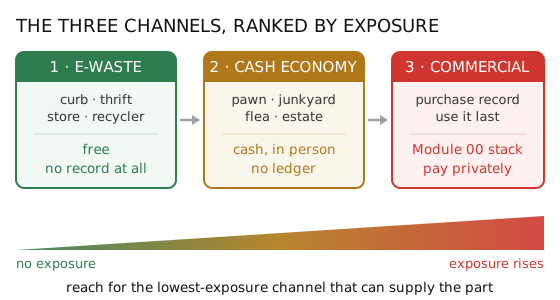
You source through three channels, ranked by how much each one exposes you. E-waste comes first: discarded electronics from the curb, the thrift store, and the recycler, free and carried off with no transaction that ties a part to you.4 The cash economy comes next, covering pawn shops, junkyards, flea markets, and estate sales; cash leaves no financial trail, and a junk dealer's legally required records show who sold to the dealer, not who bought, so a cash purchase puts no ledger entry against you.8 The cost is that you meet a seller face to face, so here the exposure is the visit itself, not a paper trail. Commercial channels expose you the most, because a card or an account normally ties your name to what you buy. You use them last, only for what you cannot salvage or find, and even then you blunt that exposure by paying through the hardened, private stack you built in Module 00.
What to salvage and where
A broken inkjet printer on the curb holds a stepper motor, a DC motor, and the rollers and gears of an actuator; a discarded laptop pack holds a row of 18650 lithium cells. Open a discarded device and you find motors, switches, magnets, gears, shafts, pulleys, belts, lenses, and lots of screws.1
Resistors are too cheap to bother pulling.2 Keep motors of any kind, connectors, hookup wire, seven-segment LED displays, loudspeakers, switches, large transistors and diodes, large or unusual capacitors, and screws, nuts, and bolts.2 Do not desolder what you can cut: snipping parts free with wire cutters is fastest, as long as the leads left behind are long enough to use.2
Reconnaissance and planning
You plan a run before you make it. This is open-source intelligence, OSINT: building a picture of a place from public, freely available sources.47
Start with a shopping list. Before you go out, develop a supply-search plan. Volume III’s Scavenge Kit and Protocol sets the first step as “creating a ‘shopping list’ of primary items you are searching for.” It continues: “From this, you can better identify locations which have a higher probability of having those items present. This also helps prioritize what items are of the greatest value on a particular run and opens options on what can be left behind for next time.”3
Find the sources from your desk. OpenStreetMap is a free, public map of the world that anyone can query. Overpass Turbo, at overpass-turbo.eu, runs a query against it and plots the results. You ask it for the kinds of place that hold discarded electronics, and it returns them by name and address. Paste this into the query box, move the map over your area, and press Run.44
[out:json][timeout:60];
(
  nwr["amenity"="recycling"]["recycling_type"="centre"]({{bbox}});
  nwr["industrial"="scrap_yard"]({{bbox}});
  nwr["shop"="electronics"]({{bbox}});
);
out center;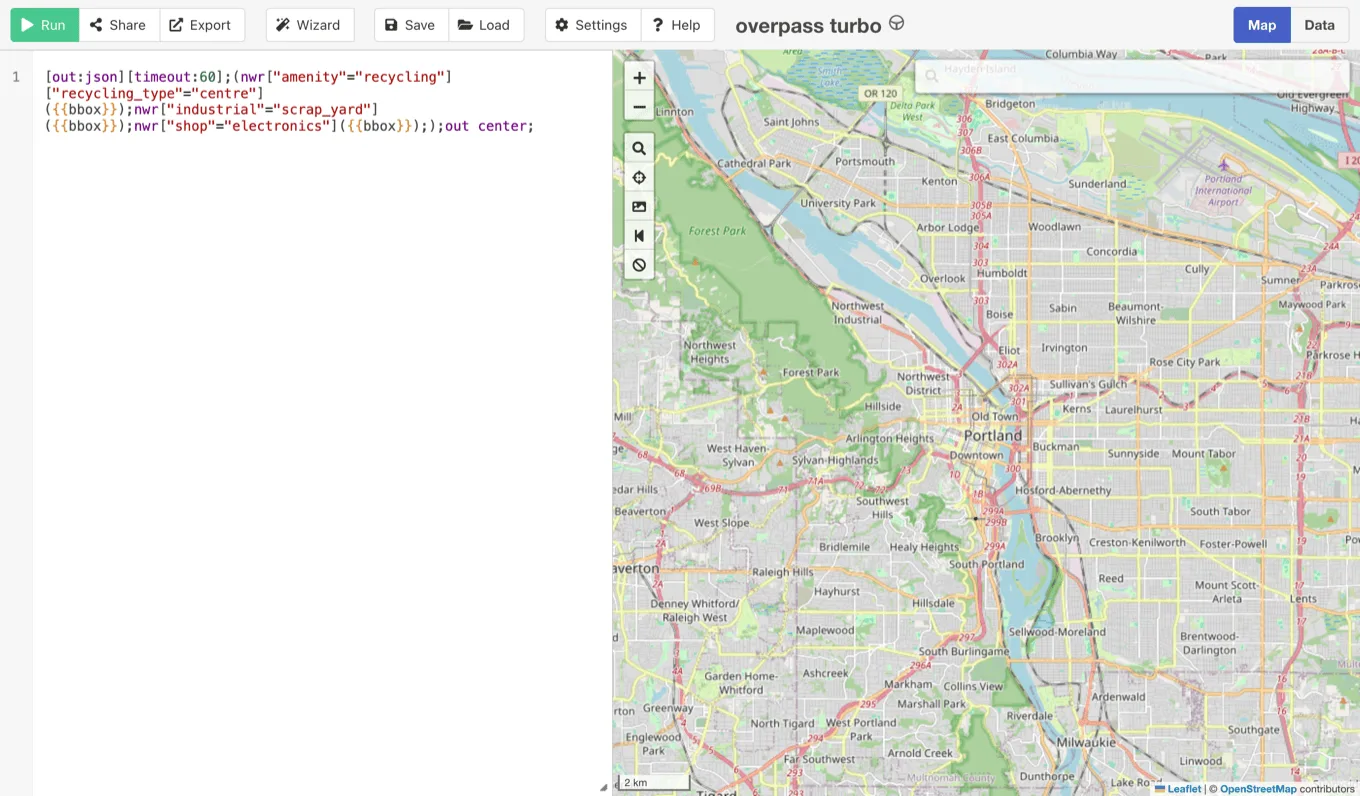
The query asks for three kinds of place: recycling centres (amenity=recycling), scrap yards (industrial=scrap_yard), and electronics shops (shop=electronics). Change the tags to narrow it: recycling:electrical_appliances=yes or recycling:computers=yes returns only the drop-offs that take e-waste.44 Run over one city and you get every candidate at once, each with a name, an address, and often hours and a phone number.
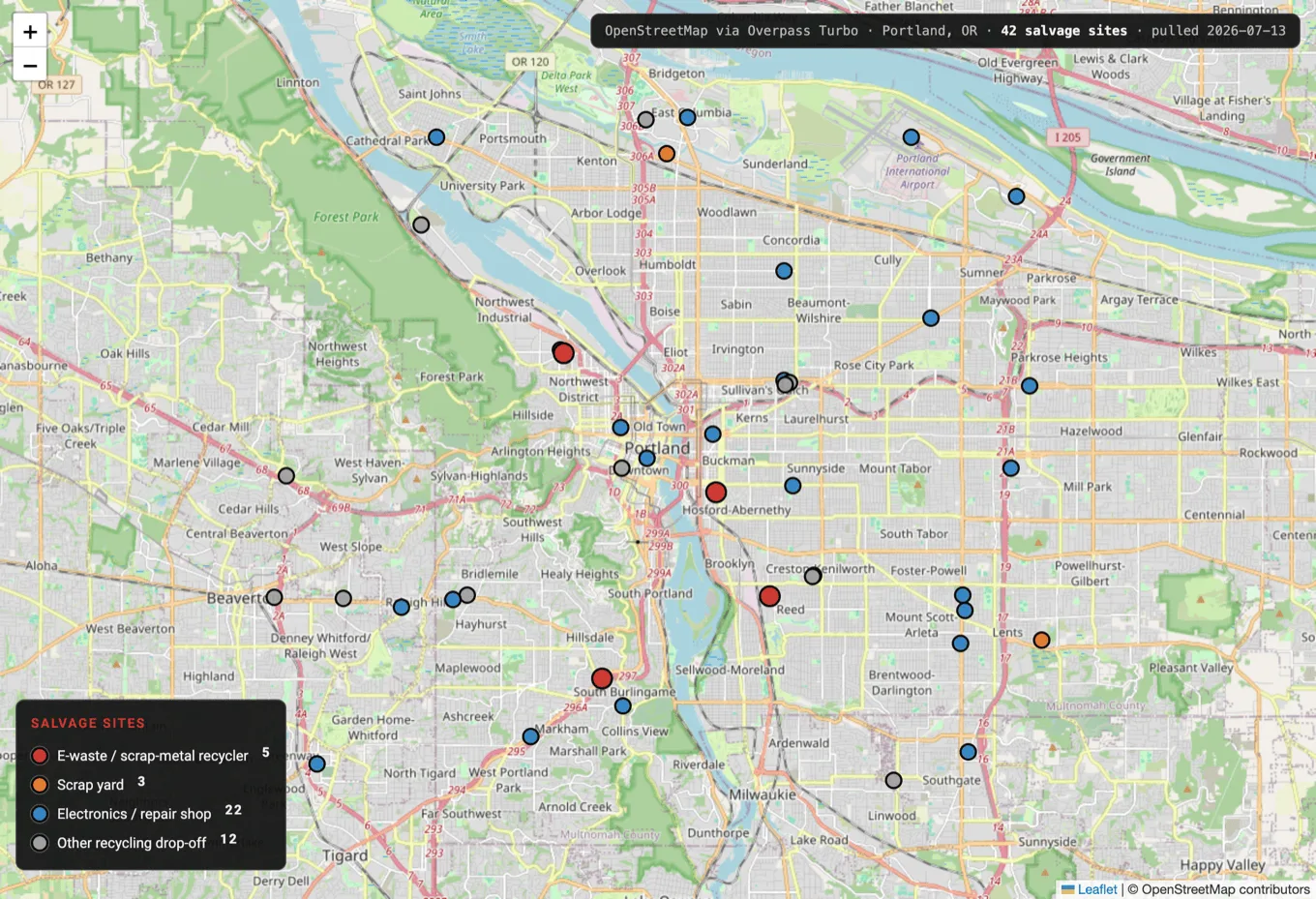
Do not overlook commercial sources. Volume III names what this takes: “An understanding of supply chain processes, incorporating a keen eye while conducting reconnaissance prior to moving in on a target. Having knowledge of health and labour codes, building codes and fire/life-safety codes in built-up areas can also afford opportunities to scavenge oft-forgotten supply sources in commercial and retail spaces.”3
Study the site from above. Once you have an address, look at it before you drive to it. Satellite and aerial imagery show the yard, the buildings, the perimeter and its fences, the gates, and where a vehicle can approach.
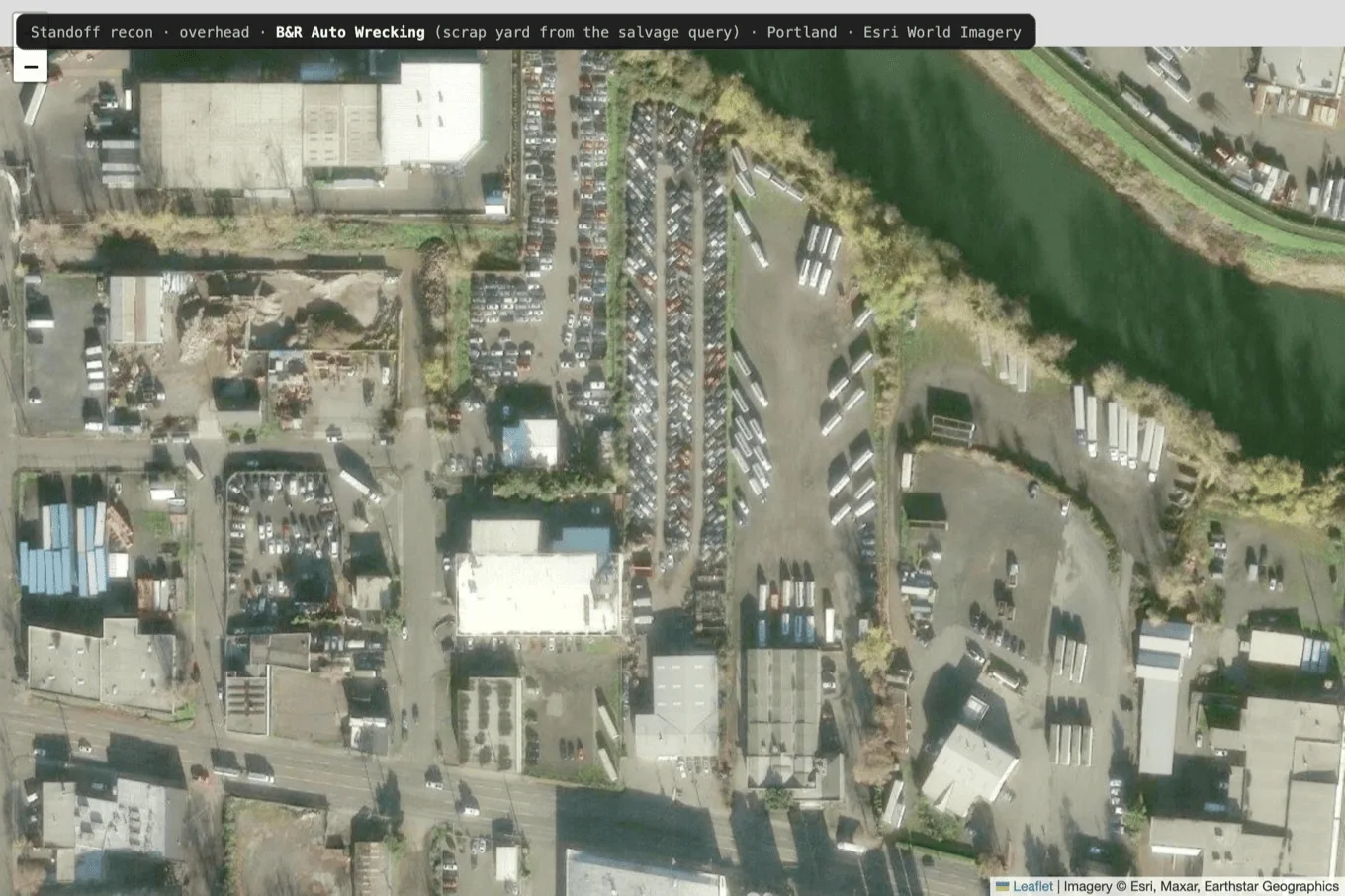
Imagery is dated, so treat it as a starting picture and confirm it on the ground: “do a proper reconnaissance of the site during day and night to judge when best to make an attempt. A study of human and animal movement patterns, along with a meteorological forecast may also play into your computations when planning.”3
Map who is watching. The same OpenStreetMap data records surveillance. Automated license-plate readers, the fixed cameras that photograph every passing plate, are tagged man_made=surveillance with surveillance:type=ALPR, and the DeFlock project has mapped these into OpenStreetMap.45 Query them the same way, or read them straight off DeFlock's map.
[out:json][timeout:60];
node["man_made"="surveillance"]["surveillance:type"="ALPR"]({{bbox}});
out geom;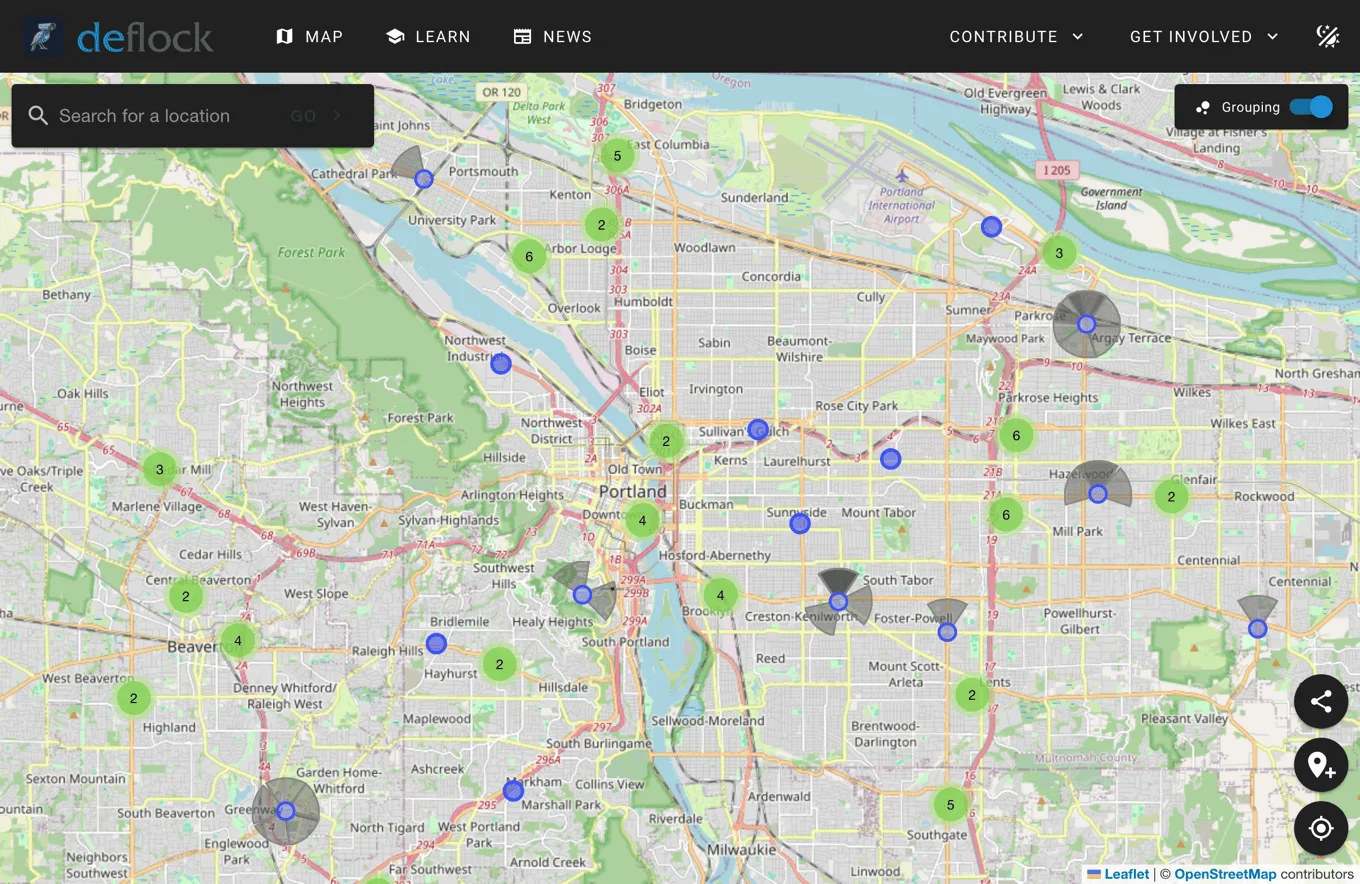
This matters because the readers are networked. Flock Safety, one vendor, runs cameras for thousands of police departments and shares the reads across them, so a plate photographed by one agency's camera can be searched by another.46 The Supreme Court held in Carpenter v. United States that obtaining a person's historical cell-site location records is a search that needs a warrant, and called its own decision “a narrow one.” Whether that reasoning reaches plate-reader networks is a question courts are still split on, so no settled rule restrains those networks today.46 A pull you pay for in cash leaves no ledger, but a reader that photographs your plate at the yard's approach places you there anyway, so you learn the cameras on your route before you drive it.
Assess the hazards, and keep a way out. A scavenge site has active and passive security measures, people who seek to protect their property, and guard animals, as well as the hazards inherent in the site: chemicals, gas lines or tanks, pipes, trip hazards, unsound structures such as floors, roofs, or walls, electrical shock risks, sharp objects, confined spaces, heights, and icy or slick surfaces.3 You reconnoiter and plan for all of them before you move, to keep the run as safe and low-residual as possible.3 One rule is absolute: “always have an escape or abort plan and always, ALWAYS have a way out.”3
Plan how you carry the parts. “The ‘gopher bag’ or a scavenger kit is a bag or load-out specifically for scavenging an area from an established base of operations,” and it “should be tailored towards stealth and mobility, but with the added consideration to have expandable carriage options.”3 Plan how you get the parts back to base intact, without compromising your mobility or safety.3
Then run the same searches on yourself. Volume I states the reason: “Gathering OSINT on yourself is a great exercise to help you understand what information you are gifting to those that can use it against you.” You cannot control everything about you that is online, but “it’s vital to be aware of what is.”47
The tools, and how to use them
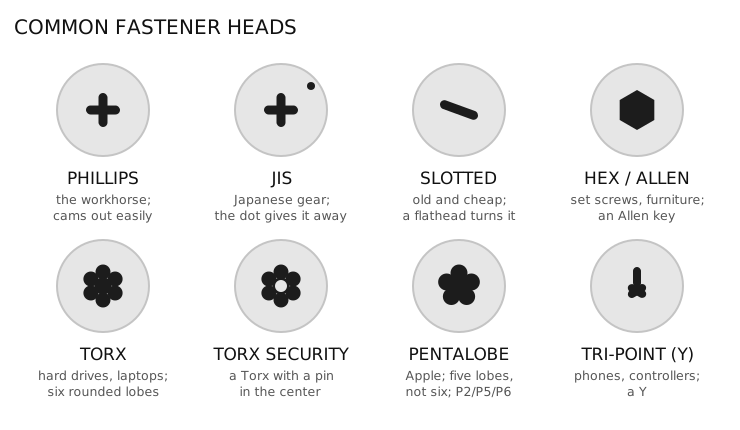
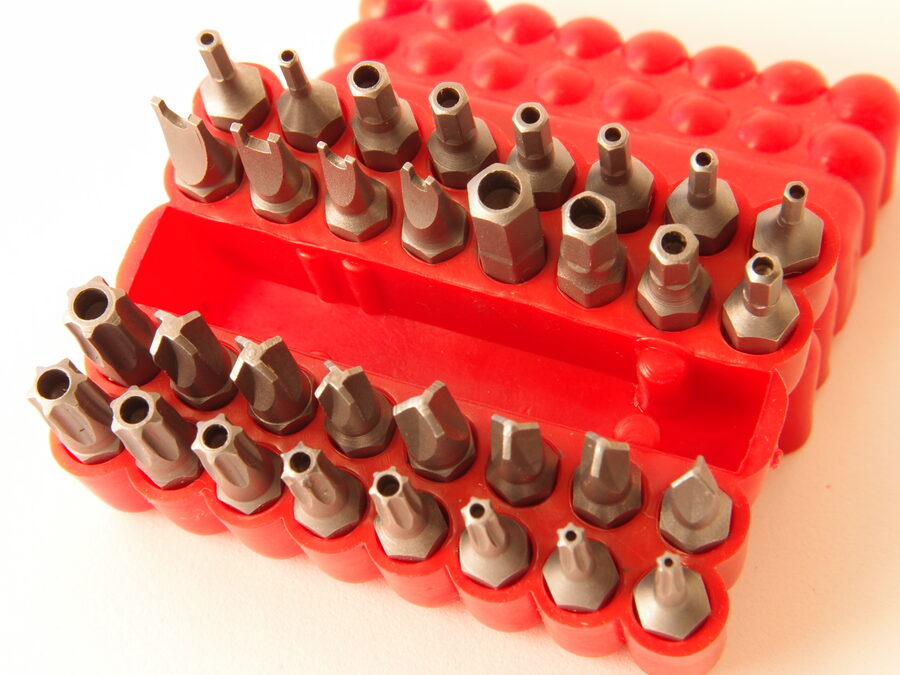
- The bit driver and its security bits. Pentalobe alone comes in three common sizes, P2 on a phone and P5 or P6 on a laptop, and it is a five-point head, not the six of a Torx, so the two do not interchange.27 One fastener looks like a plain Phillips but is not: a Japanese JIS head has square corners in its cross where a Phillips has tapered ones, so a Phillips driver cams out and strips the head.27 Match the bit to the screw: if a driver slips in the head, it is the wrong bit or the wrong size, and every slip costs you the screw. Stop and swap before the head rounds.
- The spudger and the picks. Work a clipped case along the seam clip by clip, not all at once: forcing one point is how tabs snap.14
- The heat pouch. Heat first, pry second: a glued case gives only once the adhesive has softened, and prying it cold is how screens crack.14
- The stripped screw, in order. When a head rounds and the bit just spins, work through these in order and stop at the first that holds: lay a wide rubber band over the head and turn through it, so the rubber fills the stripped recess and grips;35 if that fails, use a screw extractor, a reverse-cut bit that bites as it turns counterclockwise. The rotary tool is the last resort: cut a fresh slot across the head and back it out with the flathead.1,35 That same tool opens a molded case with no fasteners at all, but never for exploring.1
How to salvage
Eight rules apply to every teardown.1
- Cut off any power cords. Snip the cord and bend the prongs outward, so the plug can never go back into an outlet.1
- Protect your eyes. Springs jump, bits of metal and plastic fly, and tools slip, so wear glasses or, better, safety goggles before the first screw comes out.1
- Pry away from you. Most teardown injuries happen when a screwdriver under hard pressure slips. Keep the blade pointed away from your hand and your body, so a slip travels away from you.1
- Do not force the device apart. No hammering and no sawing it open. The person who assembled the device did not force the parts into place, so you should not need to force them out; if you are stuck, look for the fastener or tab you have missed and try a different approach.1
- Watch out for capacitors. Most are harmless, but some hold enough charge to knock you to the floor, and the worst can kill.1
- Lefty loosens. Almost every screw backs out counterclockwise.1
- Wash your hands. The materials inside electronics do not belong in your body. Wash your hands when you finish, and do not eat or drink while you work.1
- If you don't know what it is, don't cut into it. A rotary tool is for a case you have chosen to open, never for exploring. Cutting blind into a sealed component can release material you do not want in the air.1
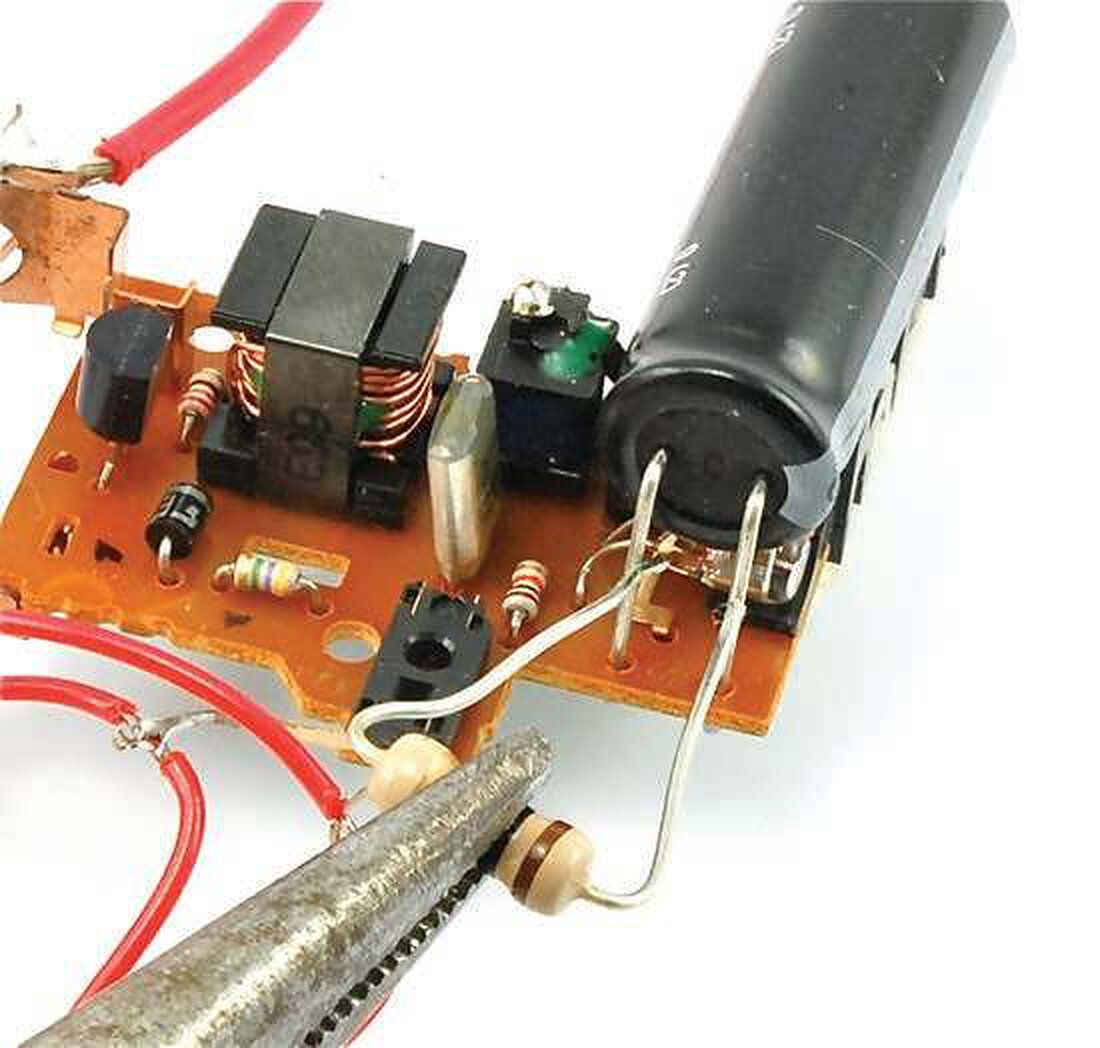
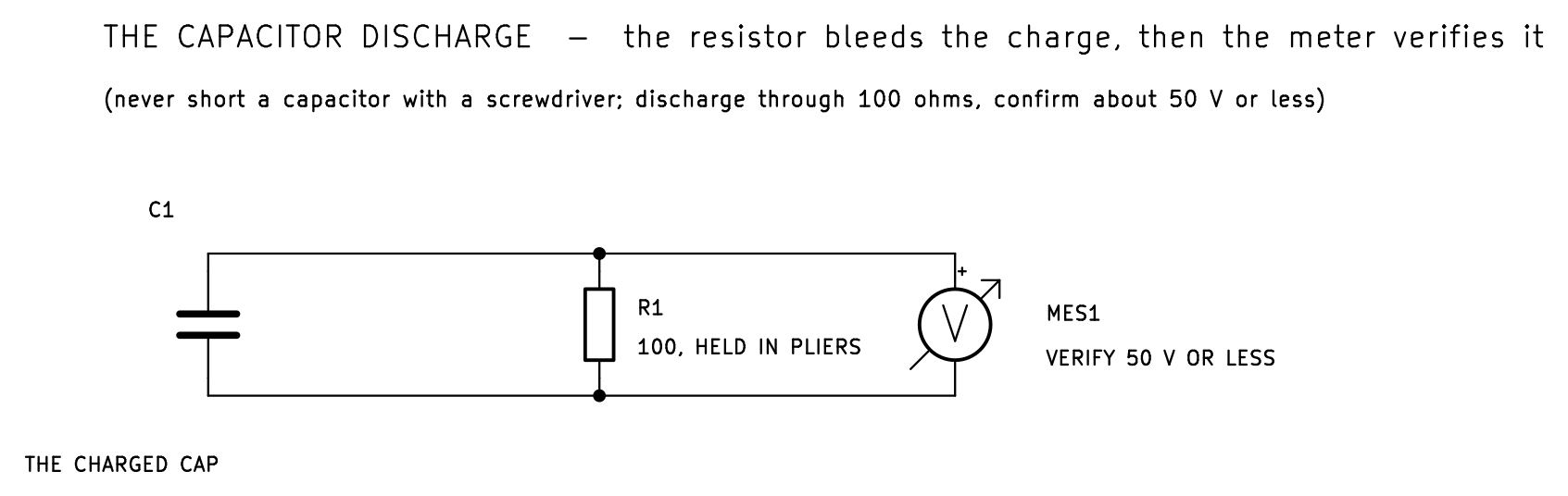
- Size the resistor to the board. Two cases, and you decide which one you have before you build the tool. A low-voltage board, the logic and signal side of a device that runs from a wall adapter or a battery, takes a 100-ohm resistor.2 A high-voltage board, meaning anything downstream of the mains: a switch-mode or linear power supply, a camera flash, or an audio amplifier's filter bank, takes a 100-kilohm 1-watt resistor, or the same value made up of two 56 k in series or two 220 k in parallel.42 Use the high-voltage resistor whenever you are unsure: it only makes the bleed slower. A higher-wattage resistor is better; an overloaded resistor breaks, but not as dangerously as a capacitor discharged the wrong way.2
- Discharge before you touch. With the device unplugged and the cord already cut off, bend the resistor's legs to match the span of the capacitor's two terminals. Hold the resistor by its body in the teeth of a pair of pliers, gripping the insulated handles, and press a resistor leg to each terminal so the charge drains through the resistor instead of across an arc.2 A low-voltage capacitor takes a few seconds; a mains-side or amplifier filter capacitor through the 100-kilohm resistor takes about a minute, and sometimes longer.42
- Verify on the meter. Set your multimeter to its highest DC voltage range and read across the terminals.2 The number to reach is a couple of volts or less, and you do not put your hands on the board until you have it.42 Discharge each capacitor on the board in turn, verifying each one.42
Only a very small capacitor should ever be discharged by shorting its leads with a screwdriver; a large one at high voltage can dump a huge charge in a fraction of a second, melting the tip and flinging molten metal.2
A flat-panel TV or monitor has no cathode-ray tube, so it holds none of the years-long CRT charge the warning above flags, and you can open one with care. What it does have is a backlight and a switch-mode power supply board, the same class the discharge drill is for.2 An older panel lights the screen with a cold-cathode fluorescent lamp, a thin glass tube filled with mercury vapor;20 a newer one uses LED backlights instead. You often cannot tell which you have until the panel is open, and the EPA states that “mercury is used in LCD screens and monitors,”16 so treat any backlight as fragile and never crush or break it.
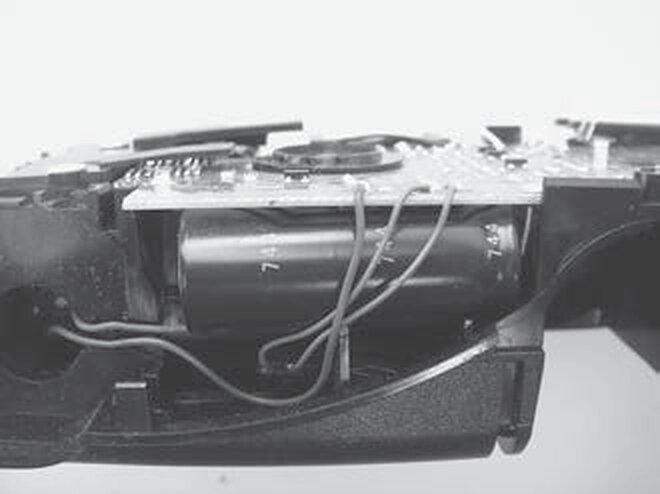
Keep the screws in order as they come out, laid on the bench in the pattern they held or pushed into a scrap of foam, because they are rarely all one length.2 Photograph any step you are not sure you can reverse.2 Screws alone rarely open a modern case; the other closures come apart like this:
- Snap-fit clips. They run along the seam. Find them with a pick and release them one at a time. Feel the resistance as you work: a clip about to break resists differently from one about to release.
- Plastic rivets. Lever them off with a flathead worked under the plate they hold.1
- Adhesive. Heat first, then a slow pry, as in Unit 04, or a solvent remover run along the seam and given two or three minutes to soften the bond before you lift.28
- Parts closed for good. A black epoxy blob over a chip is a bare die sealed under epoxy to protect it, built to last the life of the device;1 a part potted solid in resin is shut the same way. Neither comes out intact, so you take what surrounds it and leave it.
A salvaged board's switches, connectors, and chips come free only with a desoldering tool. The one rule that saves the part is patience: never pull on a lead before the solder in its joint has fully melted, because the copper pad and its trace tear off the board with the part and the joint is ruined. Soldering and desoldering are a bench skill of their own, with a standalone trainer in the series LABS; run it before your first board-level pull.
Read the documentation
A pulled board carries parts whose numbers mean nothing to you. A mass-produced device documents itself, though, in three places you can reach: its regulatory filing, its service literature, and the datasheets of the chips on it.
The regulatory filing. Anything that transmits radio (a router, a phone, a wireless mouse, a remote) and is sold in the United States carries an FCC ID printed on its label, and that ID opens a public file. The ID is two parts: a grantee code the FCC assigns to the maker, and a product code the maker assigns to the device.29 Type it into the FCC’s Equipment Authorization Search, or a mirror such as fccid.io, and the file opens.
The file always carries the label and its location on the device, the radio test report, and the exposure data. It usually carries external and internal photographs and the user manual, held back only for a 180-day window and then released.29 But the maker may withhold for good the very exhibits a salvager most wants: the schematic, the block diagram, the written description of how the thing works, and the parts list.29 Only a device printed with an FCC ID string has a file; the FCC logo mark alone is not an ID and opens nothing.29
Service manuals and datasheets. Many appliances and older consumer devices have a service manual the maker wrote for its own repair techs, with exploded parts diagrams and often a full schematic; search the exact model number with the words service manual. For a chip you have named, its datasheet is the authority: it gives the pin assignments, the recommended operating conditions, and the absolute maximum ratings. The two are not the same: the recommended operating conditions are the range where the part is guaranteed to work; the absolute maximum ratings must not be exceeded even for a moment, or the part can be damaged for good.36 For a salvaged part, you use the conservative one. A datasheet assumes you already know the device, but it reliably tells you what each pin does, the power it needs, the outer limits of its operation, and often an example circuit.33
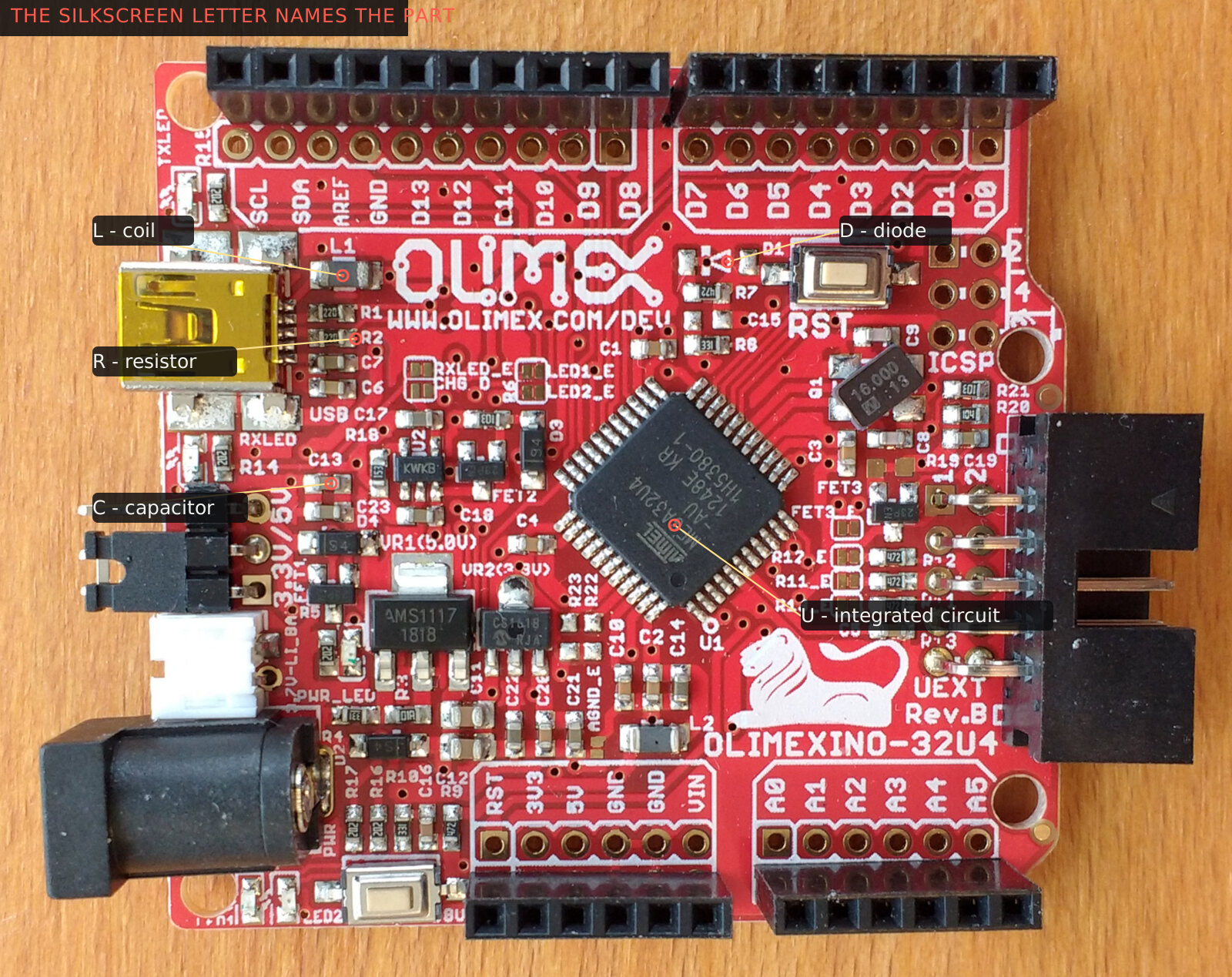
Reading the board itself. Printed beside each part is its reference designator, a standard code of one or two letters and a number.30 It is how a spot on the board maps to a line on a schematic.
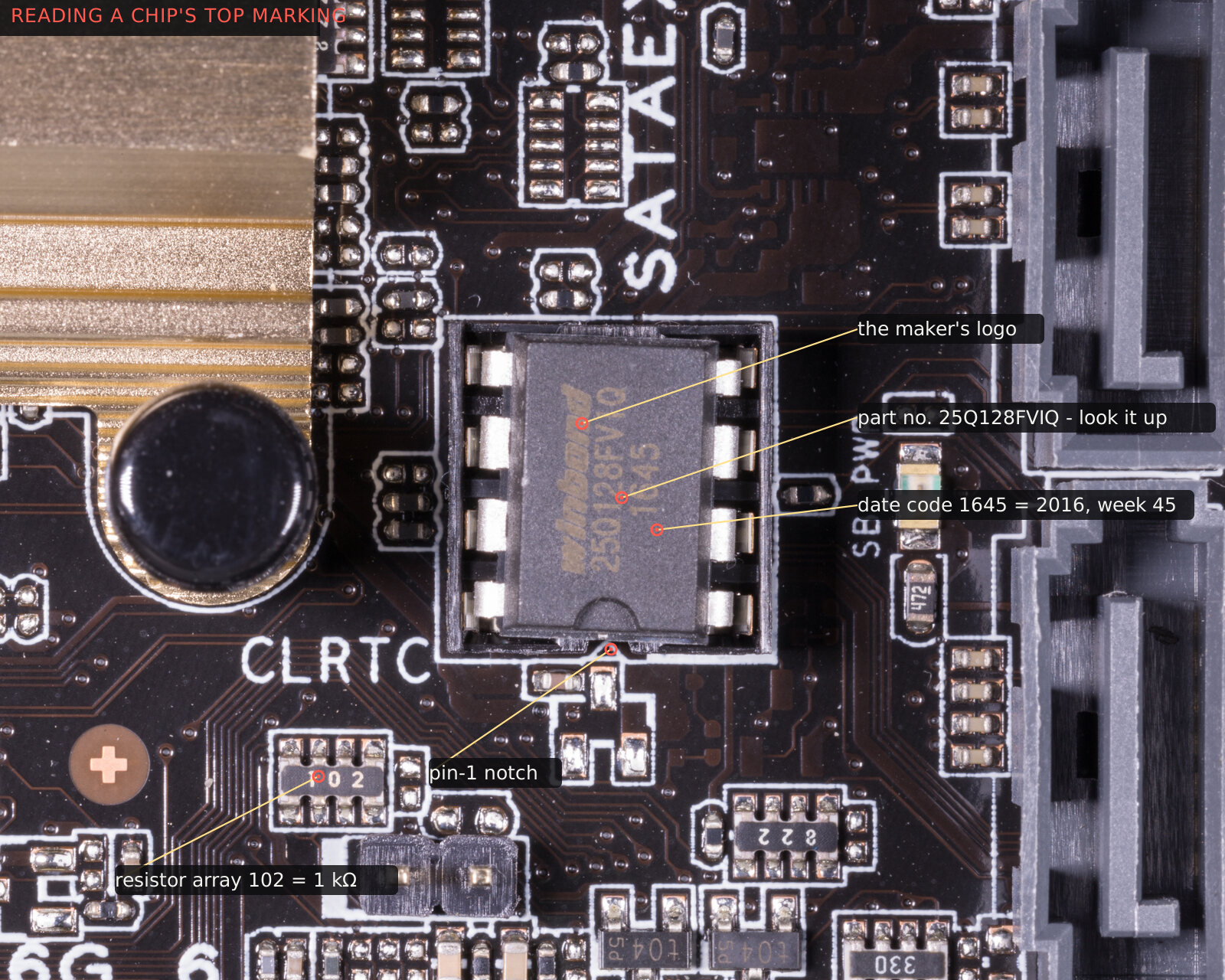
Naming a chip. An integrated circuit carries a few lines on its top: the maker’s logo, the part number, and a date code in the form YYWW, two digits of year and two of week.31 The part number is what you feed a datasheet search. Find pin 1 first, marked by a notch or a dot, with the pins counting up counterclockwise from it; the positive supply pin is labeled VCC, VDD, or V+, and ground is GND, VEE, VSS, or V−.33
The smallest surface-mount parts are too small for a full number and carry a two- or three-character code instead. The same code means different parts in different package shapes, so you read the code against the package and a code book, never on its own.32 Some chips resolve to nothing public: a house-numbered chip carries a number that maps only to the maker’s private catalog, and a sanded chip carries no readable marking at all. When the marking cannot be resolved, you test the part by how it behaves instead.
Interactive Read the board Work two real boards in order: orient a chip, pull its part number, decode the date, map the silkscreen. Open it full screen →How to test what you pulled
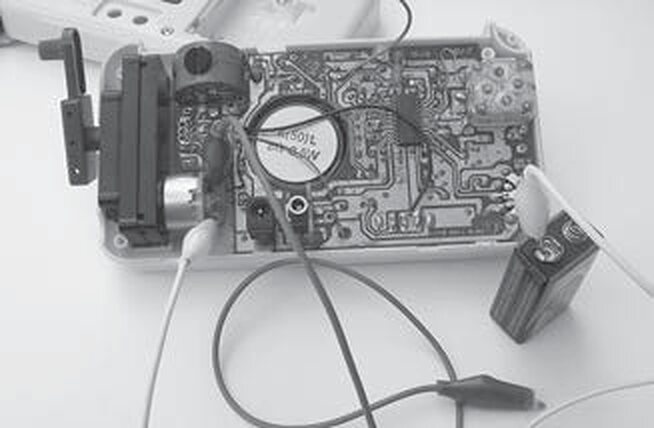
A part pulled from discarded electronics may itself have failed, so you test every component before it goes in a build; the relays, transistors, diodes, regulators, and sensors tested here are the same part families you built with in Module 03. Your tools are the multimeter from Module 02, plus two 9-volt batteries and some alligator clip leads.1
- Motor. Set the meter to ohms and read across the two tabs, then turn the shaft by hand and read again. A small DC motor reads a low resistance that changes as the shaft turns, roughly 0.5 to 10 ohms, because the commutator segments switch under the brushes as it rotates.18
- A motor that reads open (OL) at every shaft position has a broken armature winding; discard it.18
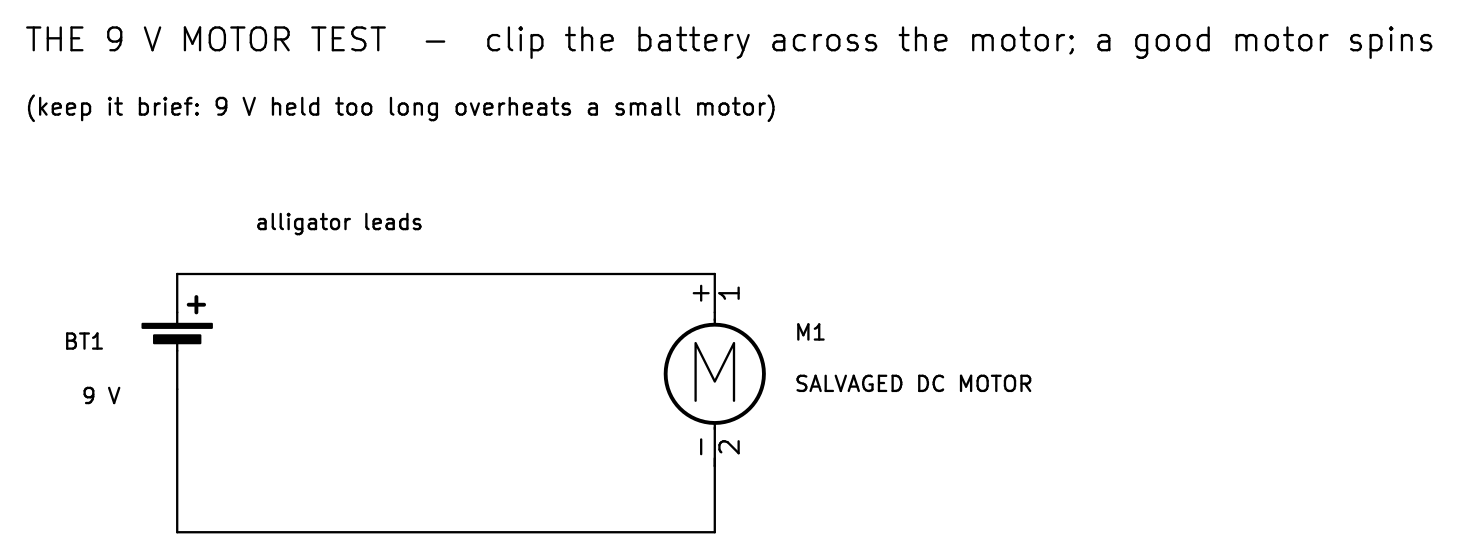
- Clip an alligator lead to each tab and touch the free ends to a 9-volt battery, and the shaft should spin, which confirms the winding, the brushes, and the gear train together.1 Hold it only a second or two, since 9 volts is more than a small motor was built for.
- Switch. A good switch's contacts read a very low resistance when they are closed, and they read open when they are not,19 so you test one directly in continuity mode. Set the meter to continuity and clip a lead to each contact.
- Work the switch. It should give a tone, a near-zero reading, when you press it closed, and fall silent, reading OL, when you release it.
- A switch that never gives a tone has a contact that will not close; one that never falls silent has contacts stuck closed. Either way, discard it.
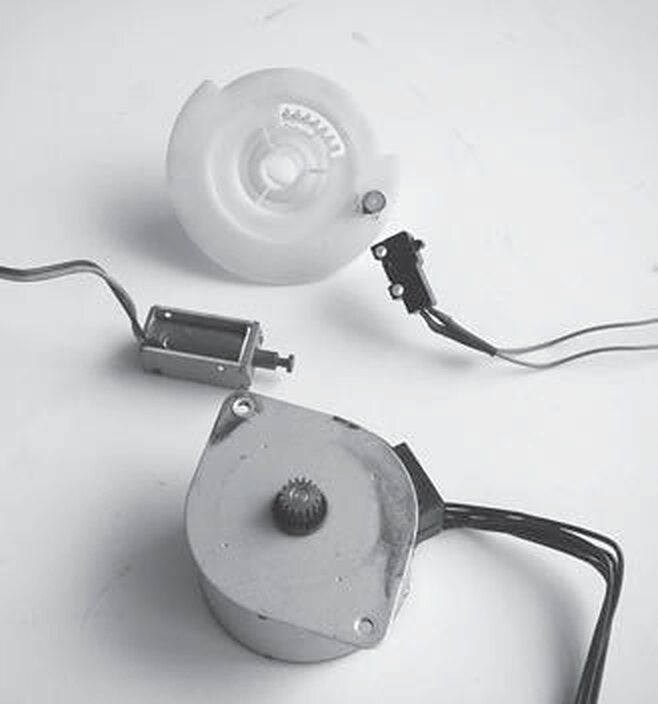
- Stepper. Set the meter to resistance; a stepper has no obvious plus and minus, so you find its coils by reading them.
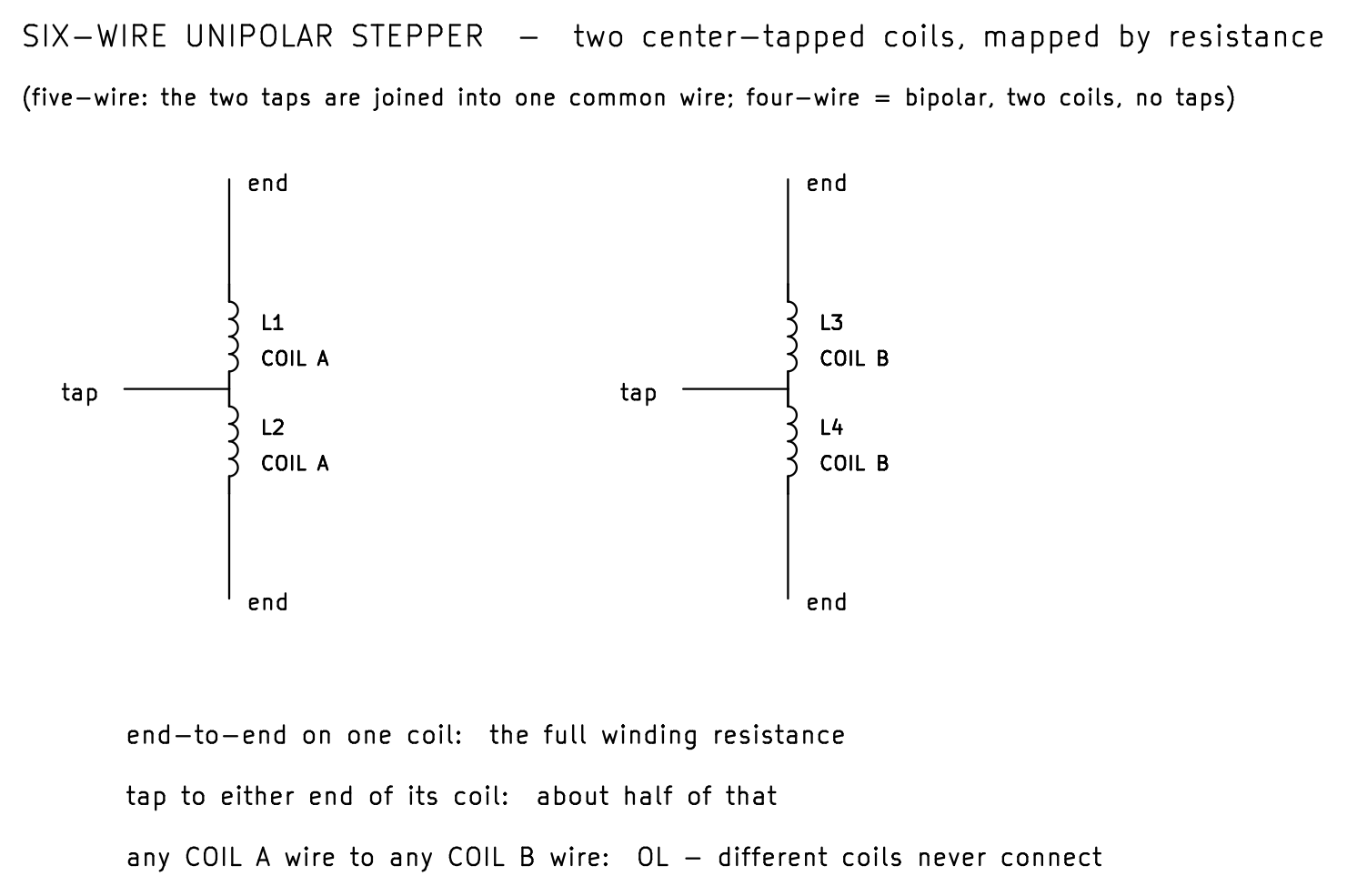
- Probe every pair of wires: two on the same coil read a finite resistance; two on different coils read open.10
- Count by the reading. A four-wire stepper is bipolar: two coil pairs, no center tap. A five- or six-wire stepper has center taps, where a tap reads a lower resistance to either coil end, which is how you find the common wire.10
- Make the call from the same readings. A coil should read a low, definite resistance, roughly 0.5 to 5 ohms on a small stepper.48 A coil that reads OL is an open winding, and one that reads far below what its partner reads has shorted turns; a resistance well under the motor's nominal value, 0.2 ohms where 1.5 is expected, is the signature.48 Either fault condemns the motor, because a stepper needs both coils to step. Last, probe one coil to the other: that reading should be OL, and any measurable resistance between the two coils is a short between phases.48
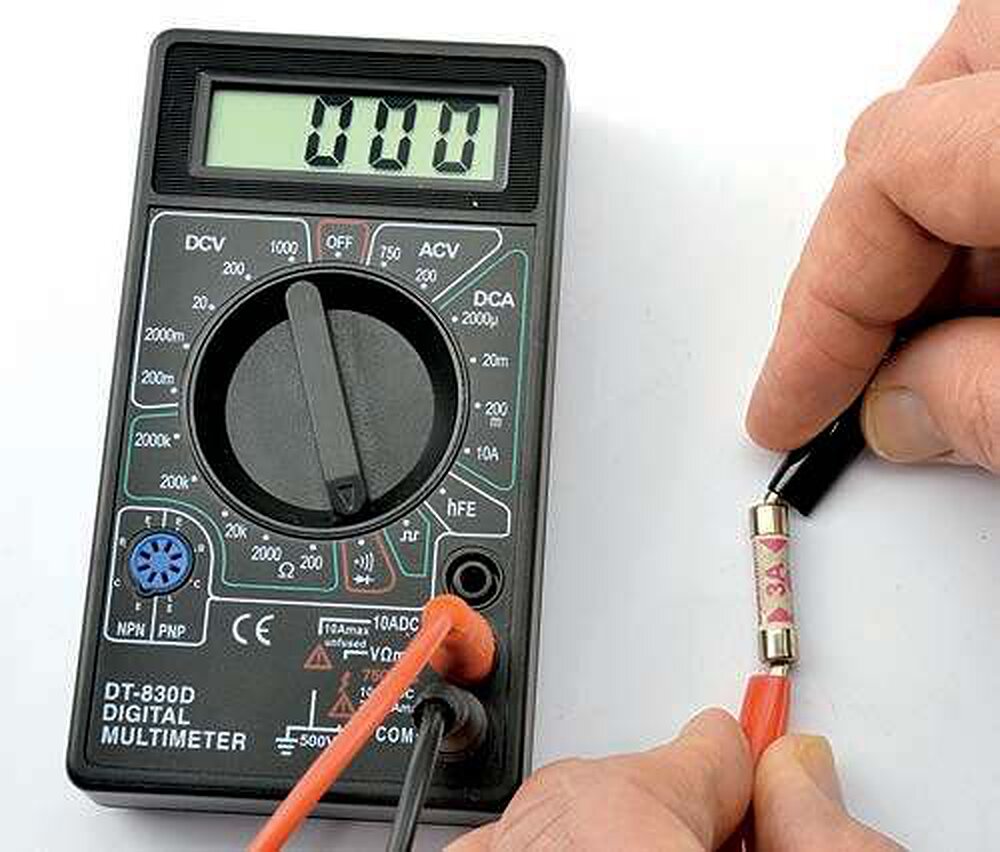
A fuse is just a wire designed to burn out when the current through it gets too high, and in a clear-bodied fuse you can see that the wire inside has broken.2
- Fuse. Pull the fuse from its holder.
- Set the meter to continuity and put a probe on each end cap. A good fuse is an unbroken wire, so it gives a tone and reads near zero; a blown fuse is an open wire, so it stays silent and reads OL.2
- If nothing else looks wrong, fit a replacement and try it. But if the new fuse blows at once, do not fit another: the device has a fault drawing too much current, and you find that before you spend another fuse.2
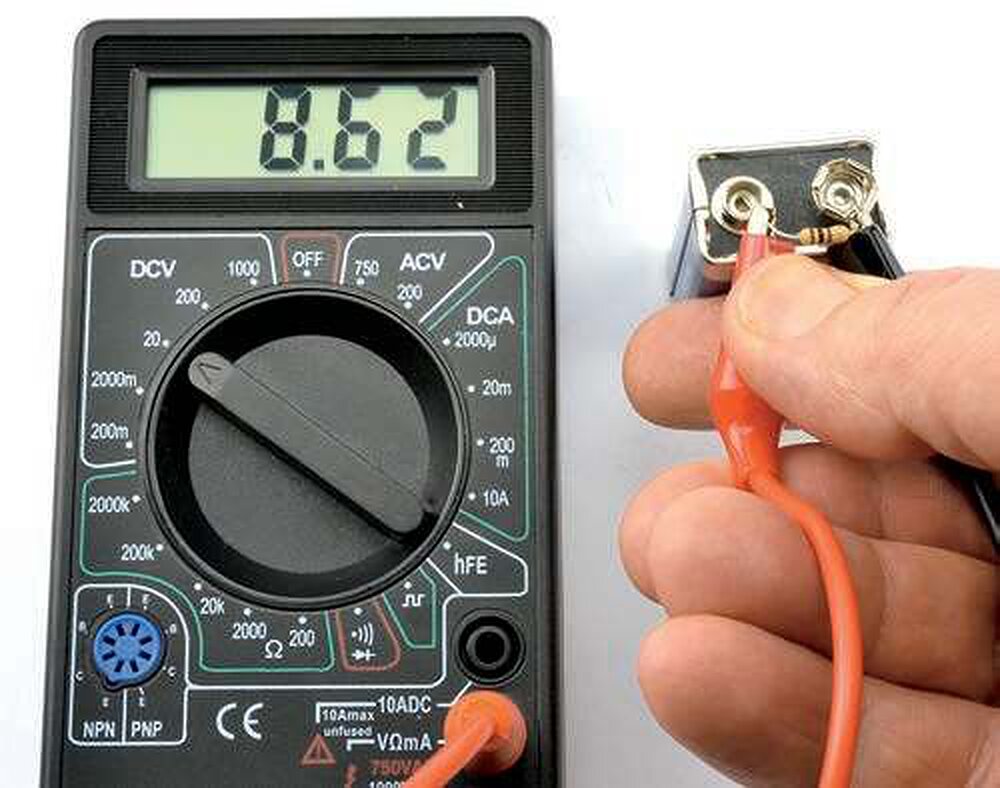
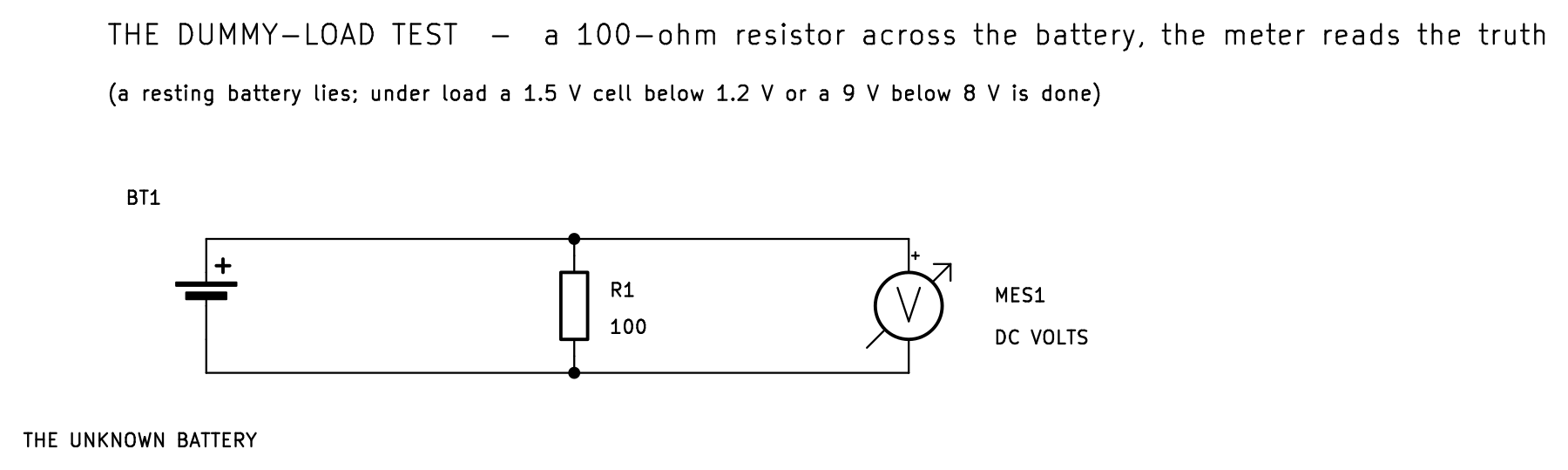
- Battery. Do not trust the resting voltage; the reading from a battery that is not powering anything can be misleading.2
- For a truer reading, clip a resistor across the terminals as a dummy load (about 10 Ω for a 1.5 V cell, 100 Ω for a 9 V battery) and read the voltage under that load.2
- Apply the threshold: a 1.5 V cell (AA or AAA) reading under 1.2 V, or a 9 V battery reading under 8 V, is probably dead.2
These are the disposable-chemistry numbers. Lithium cells are the exception flagged in Unit 02: a swollen or damaged one you leave alone.
- Diode. Set the meter to diode test. A good silicon diode reads a forward drop of about 0.5 to 0.8 volts one way and OL the other.9 A diode that reads OL both ways is open; one that reads roughly the same drop both ways, near 0.4 volts, is shorted. Either way, discard it. A bridge rectifier is four diodes in one block, so you test each of the four the same way.
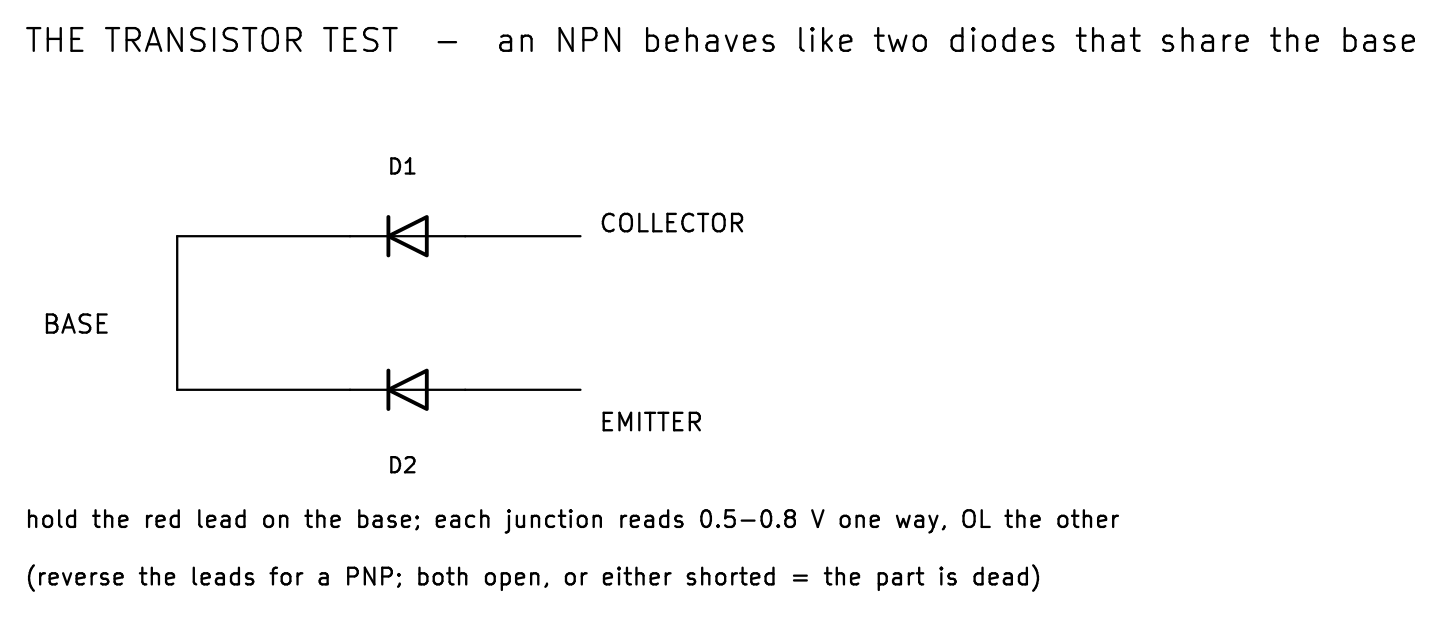
- Transistor. A bipolar transistor behaves like two diodes that share the base leg, both anodes joined at the base on an NPN.37 Set the meter to diode test, hold the red lead on the base, and touch the black lead to each of the other two legs in turn: an NPN reads a forward drop of roughly 0.6 to 0.7 volts on both, because the base is the anode of both junctions.37 Reverse the leads for a PNP.
- When the part number resolves to nothing, you find the base by probing, because the same two-diode model identifies the legs: only the base reads a forward drop to both of the other legs with one lead held on it. Put the red lead on each leg in turn and touch the black lead to the other two. The leg that reads a drop to both is the base, and the transistor is an NPN. If no leg does, swap the leads and repeat with the black lead held: the leg that then reads a drop to both is the base of a PNP. Confirm the collector and emitter against the part's datasheet before you wire it into anything, since the diode test does not tell them apart.
- Both junctions reading open, or either reading a dead short, condemns the part. A MOSFET carries a body diode across its drain and source, and the same diode test finds it: a drop of about 0.4 to 0.7 volts one way and OL the reverse, while a reading in both directions or a dead short means the part has failed.38
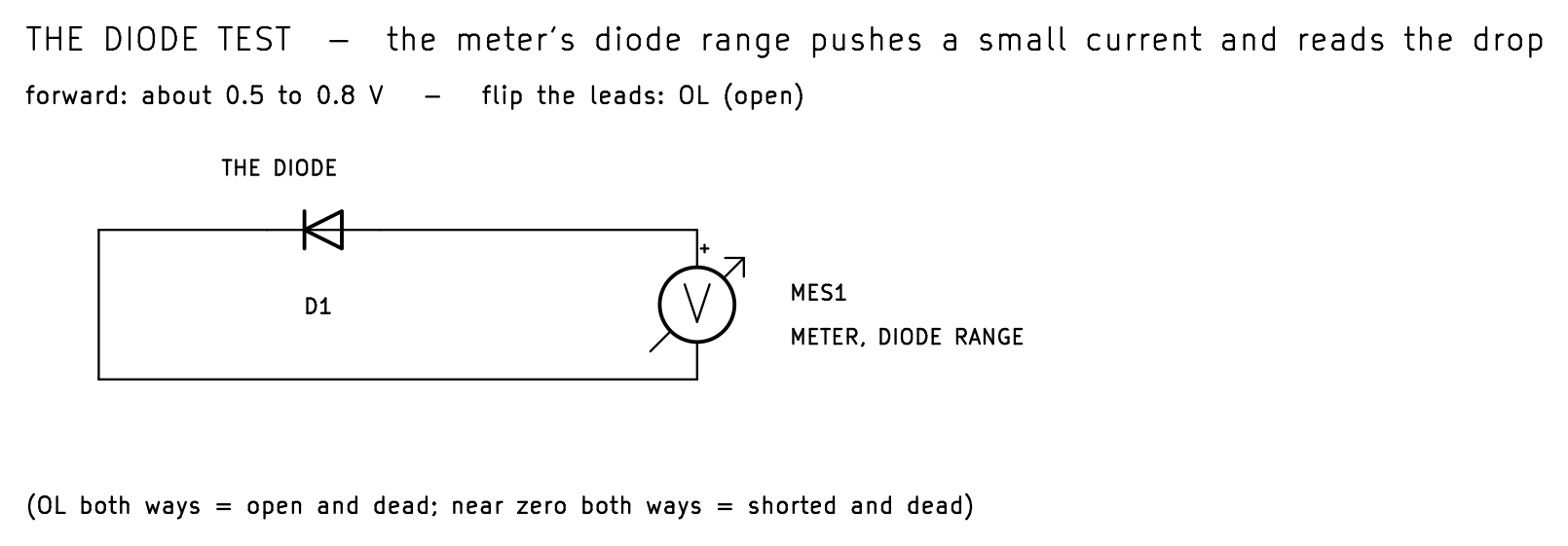
The rest of what you pull reads the same way, on the resistance and diode ranges you learned in Module 02: a good coil or winding reads low but not zero, a dead short reads zero, and an open reads OL.
The legal line
This section is general information, not legal advice, and the rules vary by state and change often, so you check your own jurisdiction.
Curbside trash. In California v. Greenwood, the Supreme Court held that the Fourth Amendment does not stop police from searching or seizing garbage left for collection outside a home's curtilage, since trash bags at the curb are exposed to animals, children, scavengers, snoops, and anyone else walking by.6 That is a limit on police searches, not a right for anyone else to take the trash, and the Court noted that states may set stricter limits of their own under their own law, which several do.6
What "abandoned" means. Throwing a thing out is not the same as abandoning it in law. Abandoned property is personal property an owner has intentionally given up all rights to and control over, which takes both the act of discarding it and the intent to give it up, and courts decide case by case whether both happened.12 Only movable property can be abandoned this way; real property cannot, so land and buildings are never fair game just because they sit empty.12 Curbside trash on collection day is the easy case, act and intent both plain. A working device left in a hallway, or goods inside a fenced lot, is the hard case, where the intent to give them up is exactly what is in doubt. On top of that sits a patchwork of state trespass and theft law and local waste-ownership rules, so the same pull can be lawful on one street and an offense on the next.
Trespass and ownership. What actually makes taking discarded goods illegal is usually one of two things. The first is trespass: entering posted or fenced private property, or property enclosed specifically to keep intruders out, which is what a locked dumpster enclosure is.7 The second is a local law that vests ownership of set-out waste in the city or its hauler; in California, for example, once recyclables are placed for collection, they legally belong to the authorized recycling agent, and removing them without authorization is an offense.7 This is the layer that most often turns dumpster diving into a crime, and it is entirely local.
Self-service yards. The way to salvage with none of this ambiguity is to pay for the right. Self-service yards let you walk in, pull parts off the stock with your own tools, and carry them out for a fee, and your standing to be there is a contract you agree to at the gate, not a guess about whether the goods were abandoned. The terms are routine: a small admission fee, cash or a major card, a minimum age of sixteen with a photo ID sometimes required, and a signed waiver before you enter the yard.13 Because the whole transaction is an authorized retail purchase, it sits in a different legal box from taking discarded goods; the only footprint is the ordinary one of any in-person buy, that you were there, on camera, and paid.
Scrap and e-waste. Selling salvage runs into scrap-dealer law. States require dealers to record each transaction. California's statute is typical: it demands a description of each item bought or sold, including its type, weight, identifying marks, and serial numbers; the seller's ID; a statement of how they came to own it; and, since a 2026 amendment, the time of the transaction, the amount paid, and the employee who handled it.8 Catalytic converters and copper carry extra rules, and these change often. On disposal, many states ban electronics and batteries from landfills, and the EPA is clear that lithium, coin, and button-cell batteries do not belong in the trash, so you recycle cells rather than bin them.8
The clear path. The pulls with no ambiguity are the ones this module leans on: your own discarded electronics, curbside items on collection day, give-and-ask networks like Buy Nothing and Freecycle, repair cafes and university or corporate surplus sales, and the self-service yards where you pay for the right. You stop at the ambiguous ones (a fenced lot, a locked dumpster enclosure, a working device left in a shared hallway) because that is exactly where a free part becomes trespass or theft. When in doubt, buy the right to it or leave it.
Field exercise
Task: Use OSINT to plan a salvage run, then source one device, tear it down by the eight rules, read what it documents about itself, and test every part you pull.
Condition: Given your own area, the Unit 04 tool kit, the Module 02 multimeter, a laptop for the OSINT, and a phone.
Standard: Three or more sites mapped in Overpass Turbo and logged, the ALPR and camera exposure on your route checked,44,45 and a shopping list, timing, hazards, and an escape plan set down before you go;3 one device sourced and its exposure noted; the case opened by the eight rules and the interior photographed before any part comes out; one part identified through the device's own documentation, by an FCC-ID lookup or a service manual; every pull tested by Unit 07's methods and labeled; the keepers boxed, the rejects set aside, and the run logged with photographs. The product of this exercise is the completed field exercise worksheet, dated and carrying the run plan, every pull with the device it came from, and what each part tested at. The sheet is the parts log the salvage bench is inventoried against.
Download the field exercise worksheet (PDF)
Salvage turns discarded electronics into the parts supply. The teardown rules apply to every device pulled, and the discharge drill applies to every unit with a mains supply, on a salvage run or off one. Source the run with open data, take only what you may lawfully take, and log every pull the way the worksheet logs it: what it is, where it came from, and what it tested at.
Module test
Task: Pass the Module 04 test.
Condition: Given ten questions on units one through seven and the legal line, with the units and your notes closed.
Standard: At least eight of ten correct. For each miss, reread the unit named in the feedback and retake until you clear the bar.
Glossary
- continuity
- A meter test for an unbroken electrical path. A good switch shows continuity when closed and none when open.
- curtilage
- The area immediately around a home that the law treats as part of it. Trash left outside the curtilage, at the curb, has no Fourth Amendment protection from a police search.
- desoldering
- Removing solder to free a part from a board, one joint at a time. Its own bench skill, with a standalone trainer in the series LABS; you cut instead wherever the leads allow.
- e-waste
- Discarded electronics: curbside trash, thrift-store rejects, and recycler stock. It is the free, anonymous channel you source from first.
- FCC ID
- The identifier printed on a device that transmits radio, opening a public regulatory file of external and internal photographs, the manual, and test reports; the schematic and parts list are often withheld for good.
- parts pairing
- Fingerprinting a component with a serial number so a genuine replacement refuses to work until the maker's software authorizes it. It is why a new part can be worth less to you than a salvaged one.
- planned obsolescence
- Building a product with an uneconomically short useful life so the customer buys again. The standing incentive that makes new hardware harder to repair and reuse.
- reference designator
- The letter-and-number code printed beside a part on a board, such as R4 or U7, that maps the part to its symbol on a schematic: R resistor, C capacitor, Q transistor, U integrated circuit.
- stepper motor
- A motor that turns in fixed steps rather than spinning freely, identified by its four, five, or six wires. Printers and drives are full of them.
- teardown
- The systematic disassembly of a device to recover its working parts. Unit 05's eight rules govern every one.
Sources
- Ed Sobey, Unscrewed: Salvage and Reuse Motors, Gears, Switches, and More from Your Old Electronics, Chicago Review Press, 2011 (Light Fighter Library, Reference/Electronics): the Rules of the Hunt in Unit 05 (eight of Sobey's nine; his first rule, the device owner's consent, does not arise for discarded e-waste), the tools list, the device-by-device guide and the Unscrewed Value Index, hidden fasteners (including the hard drive's label-hidden screw) and the cut-a-new-notch trick, wire-cutting and labeling discipline, the capacitor-discharge method and the exclusion of CRT televisions and monitors, the 9-volt and multimeter test methods, motor identification by wire count, case reuse, and the hard-drive voice-coil detail. The teardown trainer's part lists, value indexes, hazards, and photographs (device pages 17–211, including the computer fan, toy remote control, DVD player, and UPS chapters used for the power- and sensing-relevant salvage in Unit 02) are taken from this book; the trainer's step-by-step walkthrough text is the module's own paraphrase of the guide's procedures.
- Simon Monk, Hacking Electronics, 2nd ed., McGraw-Hill, 2017 (Light Fighter Library, Reference/Electronics): Chapter 11 (Mending and Breaking Electronics) supplies the capacitor-discharge standard quoted in Unit 05 (the 100-ohm resistor in pliers, the meter check to about 50 volts, the never-with-a-screwdriver warning, and the lethal-device list of CRT sets, switch-mode supplies, and camera flash guns), the be-selective scavenging list with the cut-don't-desolder rule and leads left long enough to use, the fuse and battery-under-load tests with their thresholds (the 100-ohm dummy load and the 9-volt and 1.5-volt discard lines are Monk's; the 10-ohm load for a 1.5-volt cell is the module's own scaling of his 100-ohm method), the LED forward-voltage figures cited in Unit 07, and the salvaged-fan fume extractor. Photographs credited to Monk are from these chapters' figures.
- B. Millinkovich, "Scavenge Kit and Protocol," Volume III, Light Fighter Manifesto (Light Fighter Library, LFM Publications): the gopher-bag concept and its stealth-and-mobility principle, the supply-search shopping list and how it identifies high-probability locations and what to leave for next time, the day-and-night reconnaissance rule, the site hazard categories (unsound structures, confined spaces), the escape-or-abort-plan rule, and the legal-disclaimer register this section models. The itemized load-out list is course-side and is not reproduced here.
- Guerrilla-Tech salvage working notes (SCAVENGING-GUIDE, APPLIANCE-SALVAGE, COMPONENT-REFERENCE), Light Fighter working library: the scavenge-first sourcing hierarchy, e-scooter packs carrying 30 to 42 cells with dead packs usually holding only one or two bad ones, OpenWRT-capable router thresholds (8 MB+ flash, 64 MB+ RAM), newer inkjet printers using DC motors with encoders in place of steppers, the washing machine's water-level pressure switch (a mechanical type closing contacts at a set pressure, an electronic type shifting an oscillator's frequency with the level), and the warning that a CRT's capacitor can hold its charge for years. Working notes cross-checked against the primary sources cited above wherever a specific figure is stated.
- "Technological Disobedience: Ernesto Oroza," Assemble Papers (28 April 2017) and "Belief in the Potential Object: Ernesto Oroza on Technological Disobedience in Cuba," Walker Art Center: after the Soviet collapse Cuba entered the "Special Period" (announced August 1990), during which citizens kept machines running by salvaging parts from broken ones, including TV aerials made from standardized metal trays and chargers to revive single-use batteries; Oroza traces the Aurika 70 dryer motor into "dozens of artefacts including lawn mowers, key-cutters, vegetable cutters and fans" (quoted in the body); the designer Ernesto Oroza catalogued the practice as "technological disobedience," and the armed-forces press Editora Verde Olivo published the repair-and-reuse manual Con Nuestros Propios Esfuerzos (With Our Own Efforts). On the everyday verbs of the era, inventar and resolver, see also Isabelle Rodriguez, "Inventar o resolver," Switch on Paper. Popular secondary accounts, used as historical framing only (verified 2026-07-13).
- California v. Greenwood, 486 U.S. 35 (1988), Cornell Legal Information Institute: the Fourth Amendment does not prohibit the warrantless search and seizure of garbage left for collection outside the curtilage, and states may impose more stringent constraints under their own law (verified 2026-07-07).
- Texas Penal Code § 30.05 (criminal trespass) and California Public Resources Code § 41950: notice by an enclosure designed to exclude intruders, and set-out recyclables becoming the property of the authorized recycling agent. These are jurisdiction-specific examples of a state patchwork (verified 2026-07-07).
- California Business & Professions Code § 21606 (junk dealer records), EPA, Used Household Batteries, and the Electronics Recycling Coordination Clearinghouse: scrap-dealer recordkeeping requirements, the EPA rule against putting lithium and button cells in the trash, and the roughly twenty states plus DC whose laws ban electronics from landfills per the clearinghouse's table (nineteen plus DC on the clearinghouse's own count, up to twenty-three plus DC on broader 2025–26 tallies) (verified 2026-07-12; count updated 2026-07-12 from a stale "fifteen").
- Fluke, "How to test diodes": the diode-test mode, in which a good diode reads its forward voltage in one direction and OL in the other (verified 2026-07-07; annotation rescoped 2026-07-09, the LED color figures are Monk's, src-2).
- Hackaday, "Deducing Stepper Motor Wiring": identifying a salvaged stepper's coils with a meter, where two wires on the same coil read a finite resistance and two wires on different coils read open, and finding the center taps of five- and six-wire unipolar motors by their lower readings, the pair values clustering around two levels with the coil ends reading higher. That the tap reads about half is this module's own gloss: the tap sits mid-winding (verified 2026-07-07; annotation rescoped 2026-07-09).
- Goodwill, "How to shop the buy-the-pound outlets", Consumer Reports on Buy Nothing and Freecycle, and the ARRL Hamfests and Conventions Calendar: current salvage venues, the pay-by-the-pound outlet bins, the local give-and-ask networks, and amateur-radio flea markets (verified 2026-07-07).
- Legal Information Institute (Wex), Cornell Law School, "Abandoned Property": abandoned personal property is property an owner "intentionally relinquishes all rights to its control," whether property is abandoned is "a question of fact," and "real property may not be abandoned" (verified 2026-07-08).
- Pull-A-Part, "Frequently Asked Questions": the self-service (U-pull) salvage-yard model, with a required entry waiver ("all customers are required to sign a waiver before entering the yard"), a small admission fee, a minimum age with a photo ID that "may be required," bring-your-own-tools, and payment in cash or major cards. The industry terms (self-service, u-pull-it, you-pull-it) and the major national chains named in Unit 02 (LKQ Pick Your Part, Pull-A-Part, Pick-n-Pull, Wrench-A-Part) per Junkyard Master, "Self-Service Junkyards" (verified 2026-07-08; terms and chains verified 2026-07-15).
- iFixit, Essential Electronics Toolkit, Pro Tech Toolkit, and iOpener: the current teardown tool standard, a precision bit driver with "standard Phillips, Torx and flathead bits along with special Pentalobe, Torx Security and Tri-Point bits," the spudger's "flat end…for prying and separating," opening picks "inserted into the edges of the device," precision tweezers, a suction handle for glass panels, and a heat pouch "designed to apply heat directly and evenly to case components joined with adhesive" (verified 2026-07-08).
- Material Focus, "6m vapes and pods are thrown away every week" (UK, 27 March 2026): "6.3 million vapes and pods" thrown away per week, 1.18 billion over four years, "vapes are powered by lithium-ion batteries, which if binned can get crushed or damaged and spark dangerous fires," a reduction of about 23% following the 1 June 2025 single-use ban, and "80% of the materials inside a vape can be recovered" (UK figures; verified 2026-07-10).
- EPA, Mercury in Consumer Products: "Mercury is used in LCD screens and monitors," and fluorescent lamps of all types are mercury-containing (verified 2026-07-08).
- NTC "103" thermistor reference (10 kΩ at 25°C) and Schneider Electric (APC), UPS battery service life (three to five years): salvageable appliance sensors, the refrigerator NTC thermistor, and the fact that a discarded UPS is usually a failed sealed-lead-acid battery rather than failed electronics (verified 2026-07-08).
- Hengye Motor, "How to Test a DC Motor: Step-by-Step Guide with a Multimeter": a small DC motor's resistance across the terminals reads roughly 0.5 to 10 ohms and changes as the shaft turns, because the commutator segments switch under the brushes; a reading that stays open (OL) at every shaft position indicates a broken armature winding (verified 2026-07-09).
- Fluke, "How to measure resistance with a digital multimeter": open, unconnected leads read OL; shorted leads read 0 ohms; the contacts of a good switch or relay read a very low resistance when closed (verified 2026-07-09).
- California DTSC, "Guidance for Managing LCD Devices and LCD Device UW Lamps Residuals": the light source in an LCD monitor is typically a cold-cathode fluorescent lamp (CCFL), a transparent tube filled with mercury vapor; CCFLs removed from LCD panels are managed as universal waste when recycled and as hazardous waste when disposed of (verified 2026-07-10).
- Repair Café International Foundation, "About": "Repair Cafés are free meeting places and they're all about repairing things (together)," with tools and materials on hand, expert volunteers, and electrical appliances among the things brought in for repair (verified 2026-07-09).
- University of Washington, UW Surplus Store: "The Public Store is open to the general public every Tuesday," selling computers, monitors, lab glass, microscopes, TVs, machinery, and furniture, an example of the university-surplus channel (verified 2026-07-09).
- Jeremy I. Bulow, "An Economic Theory of Planned Obsolescence," Quarterly Journal of Economics 101(4) (1986), 729–749: "Monopolists are shown to desire uneconomically short useful lives for their goods," planned obsolescence being "the production of goods with uneconomically short useful lives so that customers will have to make repeat purchases." Peer-reviewed and canonical; the module presents Swan's earlier invariance result (durability is independent of market structure) as the honest counter-position this model answers (verified 2026-07-10).
- iFixit, "How Parts Pairing Kills Independent Repair": serialization "fingerprints each component" and pairs it to one device, so a genuine battery, display, or camera moved without the maker's software authorization loses function (the battery reports it cannot be verified; a display can disable Face ID). The count of serialized iPhone parts rising from two (2015) to nine (2020) is the European Right to Repair campaign's tally, not an Apple figure. The module does not claim only Apple can ever transplant a paired part (verified 2026-07-10).
- FTC, "FTC, States Sue Deere & Company" (15 January 2025, N.D. Ill. 3:25-cv-50017, joined by the Illinois and Minnesota Attorneys General) and "FTC, States Secure Settlement with Deere & Company" (8 July 2026, by which point Arizona, Michigan, and Wisconsin had joined, five states in all): Deere gave its fully functional Service ADVISOR diagnostic software only to authorized dealers; the 2026 settlement requires Deere for ten years to give farmers and independent shops the same repair software and tools as dealers. The 2025 filing is an allegation; the 2026 settlement is the resolution (verified 2026-07-11; January state count corrected 2026-07-11).
- Electronic Frontier Foundation, "What HP Must Do to Make Amends for Its Self-Destructing Printers", and the 2019 class-action settlement: an HP firmware update, disguised as a security update, made printers reject third-party and refilled ink cartridges (reported as false "cartridge damaged" or "missing" errors); HP settled a resulting class action in 2019 (a $1.5 million fund plus injunctive terms). Cited as a firmware lock that renders a working salvaged cartridge unusable (verified 2026-07-11).
- iFixit, "Choosing the Right Screwdriver Bit" and iFixit, "Pentalobe Screwdrivers": from the first, match the bit to the screw, and a Japanese JIS screw, whose cross has square rather than tapered corners, cams out and strips a Phillips driver, so a JIS and a Phillips are "not always interchangeable"; from the second, the tamper-resistant five-point Pentalobe head, distinct from the six-point Torx, in the P2 size on iPhones and the P5 and P6 sizes on MacBooks (verified 2026-07-11).
- iFixit, "How to Use iFixit Adhesive Remover": apply the solvent evenly along the elevated edge and wait two to three minutes for it to "penetrate and soften the adhesive" before lifting the part; the companion stretch-release technique pulls a battery pull-tab slowly and evenly at a low angle (verified 2026-07-10).
- 47 CFR § 2.926 (FCC Identifier) and the FCC Equipment Authorization Search, with the FCC's confidentiality procedures (KDB 726920): an FCC ID is a grantee code assigned by the Commission plus a product code assigned by the grantee; a certification filing always exposes the ID label and location, the test report, and the RF-exposure information, and exposes internal and external photographs and the user manual after a short-term confidentiality window of up to 180 days, but schematics, block diagrams, operational descriptions, and parts lists may be granted permanent (long-term) confidentiality. Only a device bearing an FCC ID string, not merely the FCC logo, has a lookupable file (verified 2026-07-10).
- Digi-Key, "PCB Markings: Reference Designator Meanings", following IEEE 315 / ASME Y14.44: printed-circuit reference designators are one or two letters plus a number, a near-universal convention that maps a part on the board to its symbol on the schematic: R resistor, C capacitor, L inductor, D diode (including LEDs), Q transistor, U integrated circuit, T transformer, K relay, F fuse, J jack or connector, SW switch (verified 2026-07-10).
- ECIA, EIA weekly date codes (following EIA-476-A, Source and Date Code Marking): the industry-standard method of marking a component with the source and with the year and week of its manufacture, in the EIA form of a two-digit year followed by a two-digit week (YYWW) (verified 2026-07-12).
- SMD Codebook (Rückl / Fairchild lineage): surface-mount parts are too small for a full type number and carry a two- or three-character code; the same code is assigned to different parts in different package styles, so a code must be resolved against the package and a code table, not read on its own (verified 2026-07-10).
- Jonathan Bartlett, Electronics for Beginners: A Practical Introduction to Schematics, Circuits, and Microcontrollers, Apress, 2020 (Light Fighter Library, Reference/Electronics), ch. 11: an integrated circuit's package marks pin 1 with a notch or indentation, with the remaining pins numbered counterclockwise; power pins are labeled VCC, VDD, or V+ and ground GND, VEE, VSS, or V−; and a datasheet, though it assumes familiarity with the device, reliably gives what each pin does, the power requirements, the outer limits of operation, and often an example circuit (paraphrased from the Library full text; verified 2026-07-10).
- K. Kübbeler, AVR TransistorTester documentation (the "TC1"-family component tester): the tester measures a capacitor's equivalent series resistance at a low frequency with a near-rectangular signal, well below the 100 kHz sine a datasheet quotes, so its ESR value is its own; it flags its limits plainly (thyristors and triacs need more than its ~6 mA test current, and inductance accuracy is poor). Used with the standing caution that ESR does not certify capacitance, so a suspect capacitor's value is checked separately, and that fixed pass-or-fail ESR thresholds are unreliable (verified 2026-07-10).
- iFixit, "How to Remove a Stripped Screw": the stripped-screw removal ladder, least destructive first. iFixit's own steps are the rubber band laid over the head to fill the stripped recess and add grip and, as the last resort, a rotary tool cutting a fresh slot for a flathead to back the screw out; the screw-extractor rung the module places between them (a reverse-cut bit that bites turning counterclockwise) is the standard tool for the job, not one of iFixit's steps (verified 2026-07-12).
- Toshiba, "Differences between the absolute maximum ratings and the recommended operating conditions": the absolute maximum ratings are values that must not be exceeded even for a moment, or the device may suffer breakdown, damage, or deterioration; the recommended operating conditions are the narrower range within which the part is guaranteed to operate normally (verified 2026-07-12).
- Starting Electronics, "The Only Transistor Test You Need": a bipolar transistor is modelled as two diodes with their anodes joined at the base; in diode-test mode the positive (red) lead on the base of a good NPN reads a forward drop of about 0.6 to 0.7 volts to each of the collector and emitter, and the leads reverse for a PNP (verified 2026-07-12).
- NextPCB, "How to Test MOSFETs": a healthy MOSFET has an intrinsic body diode across its drain and source, so in diode-test mode it reads a forward drop of about 0.4 to 0.7 volts in one direction and OL in the reverse; a reading in both directions or a dead short means the part has failed (verified 2026-07-12).
- Volthaus Electronics Laboratory, "Electronic Components Salvage: Dumpster and Thrift Store Treasure": discarded audio power gear (a powered subwoofer or amplifier) is one of the most valuable thrift-store and curbside sources, roughly a hundred dollars of working parts in a unit, led by its toroidal transformer at $25 to $50 or more; it also yields good capacitors, power-amplifier ICs, and heat sinks, and the write-up notes an automotive ABS controller yields six high-current 12 V relays (verified 2026-07-12).
- Clever Creations, "Salvaging Components from Old Electronics": an audio amplifier or sound system yields large smoothing capacitors, power MOSFETs and transistors, voltage regulators, inductors, and a mains transformer that supplies both a positive and a negative rail (verified 2026-07-12).
- Lenard Audio Institute, "Amplifiers: Power Supply": an amplifier's capacitor-input supply is a large mains transformer (toroidal or EI) feeding a bridge rectifier of four diodes (about a 0.65 V drop across each) into large electrolytic filter capacitors, sized around 2000 µF for each ampere the supply must deliver (verified 2026-07-12).
- Mojotone, "Filter Cap Discharge Procedure": an amplifier's filter capacitors are bled through a resistor, never shorted directly across the terminals, and then read on a meter set to its highest DC range until they settle to a couple of volts or less; amplifiers can hold a lethal charge for days after last use, and a vintage tube amplifier up to 700 V DC (verified 2026-07-12).
- StereoIndex, "Arcam AVR20: AV receiver equipped with a powerful toroidal transformer": a current AV receiver (7 × 90 W at 8 Ω) built around a toroidal transformer, confirming that new amplifiers still use the same power-supply parts a salvaged one yields (verified 2026-07-12).
- Overpass Turbo and OpenStreetMap, Tag:amenity=recycling: Overpass Turbo runs an Overpass API query against OpenStreetMap and plots the result. Recycling centres are tagged
amenity=recyclingwithrecycling_type=centreand material subtags (recycling:electrical_appliances,recycling:computers,recycling:scrap_metal), scrap yardsindustrial=scrap_yard, and electronics shopsshop=electronics. The Portland query and its 42-site result shown in Unit 03 were pulled live (verified 2026-07-13). - DeFlock and OpenStreetMap, Tag:surveillance:type=ALPR: automated license-plate readers are tagged
man_made=surveillancewithsurveillance:type=ALPR; the crowd-sourced DeFlock project has mapped a large and growing number of these into OpenStreetMap, viewable on its map and queryable through the same Overpass API (the total node count is DeFlock's own and fluctuates; not independently re-verified this pass). The Portland ALPR map shown in Unit 03 was captured from DeFlock (verified 2026-07-13). - Light Fighter Manifesto surveillance-wiki and ALPR campaign material (operator-authored), and Carpenter v. United States, 585 U.S. 296 (2018): the Court held that accessing historical cell-site location information is a Fourth Amendment search requiring a warrant, and stated "our decision today is a narrow one" that does not "call into question conventional surveillance techniques"; courts are split on whether its reasoning extends to license-plate-reader databases. Flock Safety operates license-plate-reader networks for thousands of law-enforcement agencies with cross-agency search and sharing, with documented misuse (Carpenter scope corrected and verified 2026-08-23).
- Mai Singletary, “Open-Source Intelligence — An Investigative Tool,” Volume I, Light Fighter Manifesto (Light Fighter Library, LFM Publications), with the OSINT Framework: open sources (social media, public records, business filings, satellite imagery) let an adversary profile a target’s habits, locations, and vulnerabilities without alerting them; the same sources turned on yourself are a self-audit of what you are giving away. Operator-authored; Unit 03 applies its self-audit principle (turning the same open sources on your own trail), and uses its own red-side/blue-side framing.
- TechOverflow, "How to check a stepper motor for open/short circuit?": a stepper phase winding should read between 0.5 and 5 ohms; an infinite (OL) reading means an open winding; a reading far below the nominal value, such as 0.2 ohms on a 1.5-ohm motor, means a shorted winding; and one phase probed to the other should read OL, at least 5 MΩ (verified 2026-07-24).
- Omron, G2R PCB Power Relay datasheet, coil data table: rated coil resistance 47 Ω for the 5-VDC coil, 275 Ω for the 12-VDC, and 1,100 Ω for the 24-VDC, at ±10%, the concrete case behind the rule that a coil's resistance is set by its coil voltage, with an open coil reading out of range (verified 2026-08-23; replaced a secondary source whose universal "40 to 120 Ω" range would condemn healthy 12- and 24-volt coils).
- GEYA, "How to Test Relay Module in 5 Easy Steps": the coil is energized at its rated voltage per the manufacturer's specification and the audible click indicates the relay has switched its contacts, but the click is not the pass: the NO contacts must close to 0 Ω and the NC contacts open to infinite resistance when energized, and a relay that clicks without the contacts changing may be defective (verified 2026-07-24).
- Unitest, "How to Test a Transformer with a Multimeter (Step-by-Step)": a good winding shows a stable resistance, from a few ohms on large power transformers to several hundred on small control transformers, and secondary windings typically read lower than the primary, being fewer turns of heavier wire; OL or infinite resistance means the winding has failed; and any continuity between a winding terminal and the core or earth terminal is insulation breakdown, a winding-to-earth fault (verified 2026-07-24).
- Hunker, "How To Troubleshoot Electrical Transformers": with the meter on a high resistance range, a probe on a primary winding terminal and the other on a secondary winding terminal should register infinite resistance on a good transformer, and a continuity reading there indicates a winding-to-winding short (verified 2026-07-24).
- Sound Certified, "What Will A 2, 4, or 8 Ohm Impedance Speaker Measure For DC Resistance?": a meter reads DC resistance, not impedance, and the DC measurement is almost always about 30 percent below the rated impedance; its chart gives 1.2 to 2 ohms for a 2-ohm speaker, 3.1 to 4.0 for a 4-ohm, and 5.7 to 8 for an 8-ohm (verified 2026-07-24).
- Geeky Electronics, "How to See If a Capacitor Is Bad": the top or bottom of an electrolytic capacitor going convex rather than flat, a scored or cross-marked vent that has opened or distorted, and brown, reddish-brown, or black crusty residue or sticky fluid at the base or vent are each signs of failure; and a capacitor can be bad without showing any outward sign, having lost capacitance or gone high in equivalent series resistance, which visual inspection cannot detect (verified 2026-07-24).